


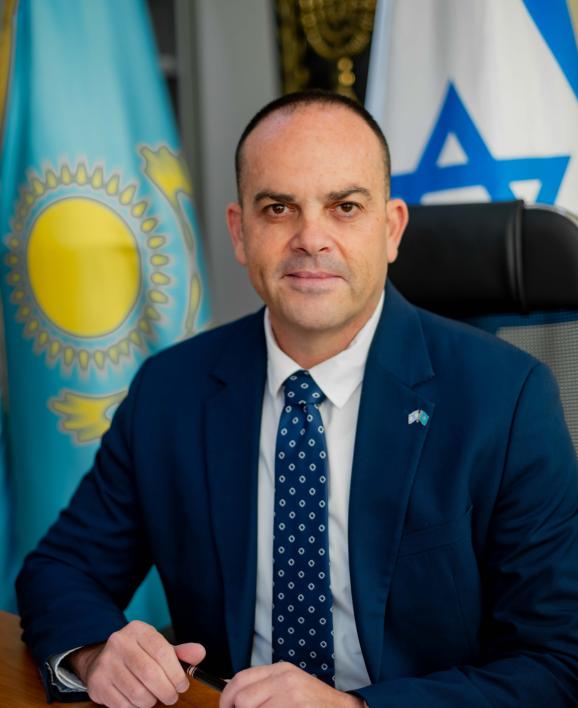

BAKU, Azerbaijan, February 17. Kazakhstan’s accession to the Abraham Accords is expected to open new opportunities for cooperation with Israel across multiple sectors, Ambassador of Israel to Kazakhstan Yoav Bistritsky told Trend in an exclusive interview.
He recalled that President Kassym-Jomart Tokayev announced in November 2025 that Kazakhstan would join the accords, although the formal signing ceremony required for them to enter into force has not yet taken place.
“Despite the fact that Kazakhstan and Israel have maintained diplomatic relations for 34 years, we believe that joining the Abraham Accords will open up new opportunities,” the ambassador said.
The ambassador explained that the move will help bring the two countries closer, elevate the level of cooperation, and enable engagement in new fields such as cybersecurity, digital technologies, and artificial intelligence, while also creating potential in strategically important sectors for the region, including water management and food security.
Ambassador Bistritsky noted that participation in the Abraham Accords could expand cooperation beyond the bilateral level.
“We are looking at the possibility of establishing a regional working group that would include not only Kazakhstan and Israel, but also partners such as the UAE, Morocco, and the United States,” he said.
The official added that a Memorandum of Understanding and Cooperation was signed between the Ministry of Water Resources and Irrigation of Kazakhstan and the Ministry of Regional Cooperation of Israel in November 2025, which could also include the establishment of a working group.
“The bilateral mechanism would provide opportunities for Israeli companies to share their expertise at the national and municipal levels. We have seen this model successfully implemented in cooperation with Azerbaijan, and we hope to share the experience of Israeli companies and the Israeli Water Authority in Kazakhstan,” he explained.
The ambassador emphasized the importance of the Joint Economic Committee, noting that it is expected to reconvene in 2026.
“We are expecting it to meet in Israel, probably around the summer or the beginning of fall. Both countries anticipate more official visits in 2026, with officials travelling from Israel to Kazakhstan and vice versa,” Ambassador Bistritsky said.
He added that ongoing and planned cooperation projects in water management, food security, tourism, artificial intelligence, digitalization, and aviation are progressing well, at either preliminary or more advanced stages, creating a solid foundation for a deeper partnership.
According to him, Israel is also looking to support Kazakhstan’s digital and AI agenda. Ambassador Bistritsky noted that Israel considers itself an advanced country in the fields of technology, digital solutions, and artificial intelligence and is interested in developing cooperation with Kazakhstan in these areas. He recalled that President Kassym-Jomart Tokayev has declared 2026 the Year of Digitalization and Artificial Intelligence in Kazakhstan.
“Israel sees strong potential to support Kazakhstan’s digital and AI development agenda. We definitely believe that Israel can support these initiatives,” the ambassador stressed.
In addition to digital technologies, Israel is also interested in expanding cooperation in the energy and mineral sectors. “Kazakhstan is an energy supplier to Israel. We are looking at ways to further strengthen this cooperation,” Ambassador Bistritsky said.
He noted that Israel could aid Kazakhstan through digitalization and smart energy solutions. “What Israel can bring is expertise in digitalization and smart energy technologies. We are exploring the possibility of launching joint projects in these areas,” he added.
The ambassador also confirmed ongoing discussions on cooperation in advanced technologies. Israeli institutions, including the Cyber Security Authority, have shown interest in partnering with their Kazakh counterparts.
He noted that Kazakhstan has recently established a new Ministry of Artificial Intelligence and Digital Development, and Israel is looking forward to building cooperation with this institution.
“We hope that in the near future we will be able to sign several memorandums of understanding related to these projects and initiatives,” Ambassador Bistritsky said.
According to him, Kazakhstan plays a strategically important role as a corridor between East and West, given its proximity to Russia, Europe, and China. “This geographical position creates significant opportunities for Israel to expand its markets beyond its borders,” the ambassador said.
He added that Israeli companies are demonstrating interest in entering the Kazakh market, either by opening offices in the country or by partnering with local firms, including within the framework of Astana Hub.
Moreover, Ambassador Bistritsky highlighted that progress is being made on a visa-free regime for Kazakh citizens travelling to Israel, noting that Israeli citizens already enjoy visa-free entry to Kazakhstan.
The ambassador also stressed the resumption of direct flights, pointing out that SCAT Airlines will begin operating from Shymkent to Israel on June 9. He recalled that Air Astana had flown from Almaty to Tel Aviv for just one month before the Gaza conflict in October 2023, and for the past two years, there have been no direct flights.
“For us, the resumption of flights is a big step forward, and we see significant potential for tourism on both sides. Together with flights and the visa-free regime, we expect a substantial expansion of tourism between Kazakhstan and Israel,” Ambassador Bistritsky added.
He concluded by underlining that both countries aim to deepen cooperation across multiple sectors in 2026.
“We are looking into concrete projects in water management, food security, tourism, AI, digitalization, and aviation. All projects are moving at a good pace, either in preliminary or more advanced stages, and we are hopeful that this year will see strong progress in these areas,” he said.



