


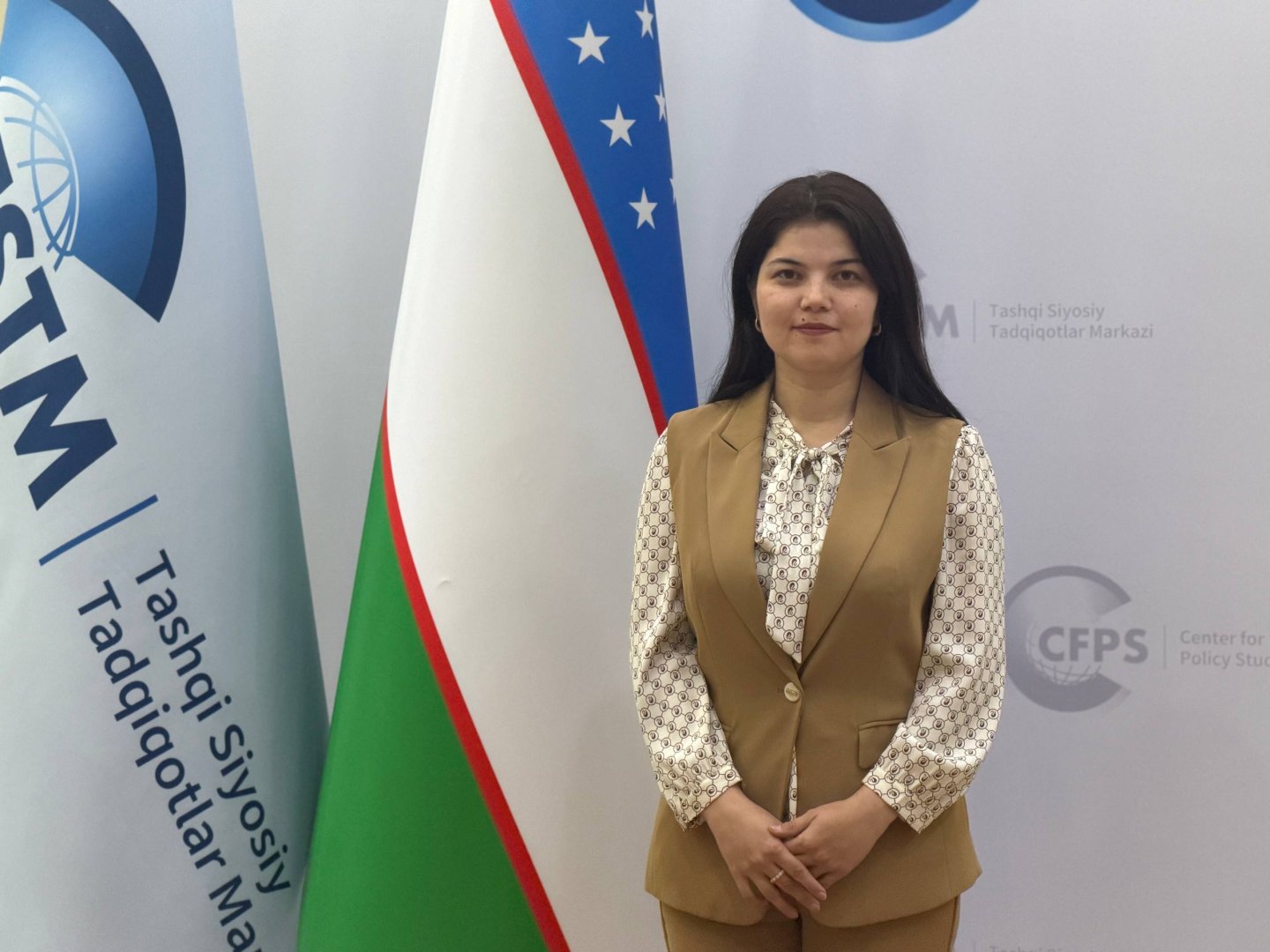

BAKU, Azerbaijan, August 21. Uzbekistan and Azerbaijan are laying the foundation for a new economic space connecting Central Asia, the Caspian region, the South Caucasus and European markets, Uzbek political analyst and Chief Research Fellow at the Center for Foreign Policy Studies Shakhodat Khoshimova told Trend.
According to the expert, relations between Uzbekistan and Azerbaijan are at a historic high, driven by strong political trust between the two countries’ leaders, close historical and cultural ties, and growing economic interdependence. “Today, our relations have already moved beyond traditional political dialogue. Trade and investment cooperation, industrial cooperation, energy, agriculture, transport and logistics are actively developing,” Khoshimova said.
She noted that an important stage in the development of bilateral relations is the transition toward deeper economic cooperation. “The next stage of Uzbek-Azerbaijani cooperation is the transition from individual joint projects to the formation of sustainable transregional production, transport and energy chains. This can become the main economic foundation of the allied relations between the two countries,” the expert said.
Speaking about prospects for expanding mutual investments, Khoshimova highlighted the significant potential of industrial cooperation. “Major opportunities exist in petrochemicals, automotive components and electric mobility, electrical engineering, pharmaceuticals and construction materials production,” she noted.
According to her, additional prospects remain in the agro-industrial sector, food processing, textiles, education and healthcare. “Technology exchange and the creation of joint export-oriented production chains are particularly promising areas,” the expert emphasized.
She also pointed out that the geographic position of Uzbekistan and Azerbaijan creates natural conditions for closer integration of the markets of Central Asia, the Caspian region, the South Caucasus and Europe.
Commenting on the development of the Trans-Caspian International Transport Route, Khoshimova noted that the Middle Corridor is gradually evolving from a transport route into an important economic link connecting regions. “For Uzbekistan, this creates additional opportunities to diversify foreign trade routes, while for Azerbaijan it strengthens the country’s role as a key transit hub between Central Asia and Europe,” she said.
According to the expert, further development of the route requires a comprehensive approach. “It is important not only to develop physical infrastructure but also to ensure coordination across the entire transport chain — including rail connections, port infrastructure, tariff policies, customs procedures, digital documentation and container logistics,” Khoshimova said.
She emphasized the special role of the Baku International Sea Trade Port in consolidating cargo flows from Uzbekistan and other Central Asian countries and facilitating their further movement along the Middle Corridor. “Additional opportunities are being created by the development of new railway links between Central Asia and China, including the China-Kyrgyzstan-Uzbekistan railway. As these connections develop, the cargo base oriented toward the Caspian and further toward the markets of the Caucasus, Türkiye and Europe may expand,” the expert said.
According to Khoshimova, the importance of the Middle Corridor goes beyond transit. “More efficient transport connectivity creates conditions for the development of trade, investment, logistics infrastructure and new production chains. Therefore, transport infrastructure is becoming one of the key factors shaping broader economic interdependence among the countries of the region,” she noted.
Speaking about the role of Uzbekistan and Azerbaijan within the Organization of Turkic States (OTS), the expert said that the two countries represent one of the most dynamic partnerships within the organization. “The significance of their cooperation lies in the fact that the two countries connect strategically important regions — Central Asia and the South Caucasus — while giving Turkic integration increasingly practical economic substance,” Khoshimova said.
According to her, investment cooperation is one of the key areas of focus. “The experience of establishing the Uzbekistan-Azerbaijan Investment Company demonstrates the potential for creating bilateral financing mechanisms for joint projects. At the same time, multilateral financial infrastructure is developing within the OTS framework, including the Turkic Investment Fund,” the expert noted.
She added that cooperation between Baku and Tashkent also contributes to the development of the Middle Corridor, expansion of trade ties, improvement of tariff policies and the introduction of digital solutions. “As a result, conditions are being created not only for the movement of goods but also for the formation of joint production and investment chains connecting Central Asia, the Caspian region, the South Caucasus and Türkiye,” Khoshimova emphasized.
The expert separately highlighted the importance of coordination between the foreign ministries of the two countries and their cooperation on international platforms. “It is important to continue close coordination between the foreign ministries in promoting common interests at regional and international platforms, strengthening allied dialogue within the United Nations, the Non-Aligned Movement, the Organization of Islamic Cooperation, the CIS and other international structures,” she said.
According to Khoshimova, expanding cooperation between Central Asia and Azerbaijan opens new opportunities for creating a broader economic space. “Through joint efforts, a new geoeconomic reality is effectively taking shape in the form of a consolidated macro-region with strong potential for shared development,” the expert concluded.



