


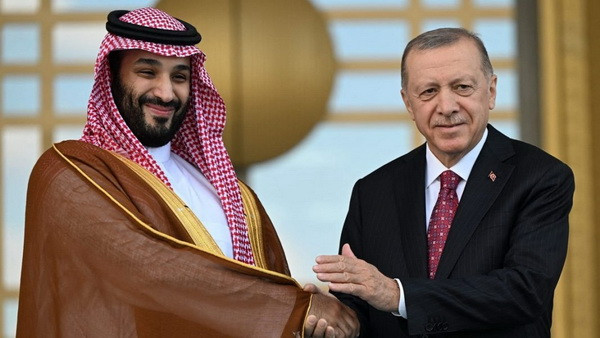

Is the emerging Turkiye–Saudi Arabia axis merely a short-term tactical convergence—or does it signal a deeper reordering of the Middle East’s security and geo-economic architecture amid America’s partial strategic retrenchment and the accelerating shift toward multipolarity?
The central argument here is that the Turkish–Saudi rapprochement, unfolding with quiet political and strategic backing from Washington, is not just another episode of normalization. It represents the institutionalization of a new model of regional governance. Within this framework, Turkiye is steadily converting its military, logistical, and political assets into the role of a pivotal security and transit hub, while Saudi Arabia is transforming its financial and investment power into a tool of diversified influence beyond the traditional oil paradigm. Taken together, these dynamics point to a qualitatively new phase of regional transformation—one that moves past the old U.S.-centric order.
The growing alignment between Ankara and Riyadh must be understood against the slow erosion of the postwar Middle Eastern security architecture, long built on direct American military dominance and rigid alliance structures. Since the late 2010s, Washington has been dialing down its hands-on involvement in regional conflicts—scaling back its footprint in Syria and Iraq, reallocating resources toward the Indo-Pacific, and shifting from a strategy of crisis management to one of balance management. In this context, the United States has a clear interest in cultivating regional “anchors of stability” capable of sharing the burden of security provision, containing destabilizing actors, and safeguarding critical logistical and energy corridors. With NATO’s second-largest army and an extensive network of military bases, Turkiye emerges as a natural candidate for that role.
President Recep Tayyip Erdoğan’s foreign policy underscores a deliberate move away from one-dimensional dependence on the West. Ankara is pursuing a layered strategy in which military, economic, and diplomatic instruments operate in sync. Turkiye has expanded its military presence in northern Syria, effectively institutionalizing zones of influence; deepened cooperation with Iraq against the PKK; strengthened coordination with Jordan and Lebanon; and projected power across the Eastern Mediterranean, Libya, and the South Caucasus. At the same time, it has turned geography into leverage—positioning itself as a connective hub linking Europe, the Caucasus, the Middle East, and Central Asia through control of key transport and energy nodes. The export of drones, armored vehicles, and naval systems has elevated Turkiye’s defense industry into a core instrument of foreign policy and influence.
For Saudi Arabia, closer ties with Turkiye dovetail seamlessly with the kingdom’s domestic modernization drive under Vision 2030. Riyadh recognizes that economic diversification is impossible without a stable regional security environment—and that overreliance on a single external guarantor, namely the United States, carries growing risks. Turkiye offers Saudi Arabia several strategic advantages: access to advanced military and intelligence capabilities, an alternative to Western arms suppliers, and a platform for building joint production chains in defense and high-tech sectors. In return, Saudi capital has become an important stabilizing factor for Turkiye, especially amid inflationary pressures, currency volatility, and the need to finance large-scale infrastructure projects.
The American role in this process is best described as one of “quiet endorsement.” The thaw in Turkish–Saudi relations has coincided with a broader warming of ties between Ankara and Washington, reflecting the United States’ pivot toward a model of managed autonomy for its partners. Under this approach, regional powers are granted greater freedom of maneuver, provided their actions remain broadly compatible with core U.S. interests. Washington appears willing to tolerate Turkiye’s multi-vector diplomacy—including dialogue with Russia and China—so long as it does not undermine the West’s strategic red lines.
The Ankara–Riyadh axis is already reshaping the region’s energy and transport geo-economics. Joint initiatives on gas, electricity, and freight transit through Turkiye—and potentially through a stabilized Syria—are laying the groundwork for an alternative integration model that directly links the Gulf to European markets. This approach lowers transit costs, weakens competing routes, and cements Turkiye’s role as an indispensable intermediary between Europe and the Arabian Peninsula.
At this stage, it is clear that Turkish–Saudi rapprochement has moved beyond bilateral normalization and taken on a structural character, mirroring deeper shifts in both regional and global order. Turkiye is no longer merely a peripheral ally of the West but an autonomous center of power in its own right, while Saudi Arabia is converting financial capital into a tool of strategic positioning and external economic influence. Together, they are helping to define the contours of a post-American, but not anti-American, Middle East.
The Consequences of the Ankara–Riyadh Axis: Shifting Balances and Paths of Regional Evolution
The emergence of a durable Turkiye–Saudi Arabia axis carries far-reaching implications for the Middle East as a whole, reshaping the distribution of influence among key powers and altering the logic of interaction between regional actors and external stakeholders.
The Iran Factor: Structural Pressure Without Direct Confrontation
The new Turkiye–Saudi alignment inevitably affects Iran’s strategic position, but its defining feature is the absence of overt antagonism. This is not a revival of the explicitly anti-Iranian bloc of the mid-2010s. Instead, it marks a gradual narrowing of Tehran’s room for maneuver as the regional environment itself evolves.
Iran faces several constraints unfolding in parallel. First, the expansion of Turkish military and intelligence presence in northern Syria and northern Iraq limits the operational autonomy of Iran-aligned proxy networks. Second, deeper security and defense-industrial cooperation between Ankara and Riyadh creates an alternative center of gravity for Sunni states, reducing their incentive to tactically hedge between Tehran and other external players.
At the same time, Ankara is careful to avoid casting itself as Iran’s direct adversary. Turkiye maintains trade ties, energy cooperation, and diplomatic channels with Tehran, treating the Iranian vector as an integral part of its broader multi-directional strategy. The pressure on Iran is structural rather than confrontational: it constrains influence without escalation, making the regional balance more predictable and, paradoxically, more stable.
Israel: Adapting to a Less Exclusive Landscape
For Israel, the rise of the Ankara–Riyadh axis signals the erosion of some of its former strategic exclusivity in relations with Sunni monarchies and the United States. Yet this new configuration poses no direct threat to Israeli security. Saudi Arabia, despite cautious engagement with Israel under U.S.-backed initiatives, prefers flexibility and has deliberately avoided institutionalizing ties in ways that could limit its diplomatic maneuvering.
Turkiye, for its part, brings a complex and often contentious history with Israel, but its current approach is unmistakably pragmatic—preserving channels of coordination, particularly in energy, trade, and regional logistics. The result is a regional environment in which Israel remains an important actor, but no longer a singular one. The architecture becomes multilayered, with security less dependent on binary alliances and more on overlapping interests and mutual dependencies.
Russia: Constrained but Persistent
Russia continues to matter in Middle Eastern politics, but its capacity to shape regional balances is steadily diminishing. Ankara views Moscow as a significant partner in energy, trade, and conflict management in Syria and the South Caucasus—but not as a strategic alternative to the West.
Turkiye leverages dialogue with Russia to bolster its own autonomy, avoiding dependency while maintaining a pragmatic equilibrium. For Moscow, this translates into a gradual shift from being an active architect of regional order to a more adaptive participant—one increasingly compelled to accommodate initiatives driven by Turkiye and Saudi Arabia as emerging centers of power.
The Red Sea and the Eastern Mediterranean: A Wider Arc of Influence
One of the most underestimated consequences of Turkish–Saudi rapprochement is its projection into the Red Sea and the Eastern Mediterranean. Control over maritime lanes, ports, and transit hubs is gaining strategic weight amid growing instability in global supply chains.
Ankara and Riyadh share interests in securing shipping routes, protecting energy corridors, and neutralizing destabilizing actors. Together, they form an extended arc of influence linking the Eastern Mediterranean, the Suez Canal, and the Red Sea—an arc in which Turkiye functions as the operational hub and Saudi Arabia as the financial and institutional anchor. Over time, this zone could evolve into a core space of economic and military-political coordination, reinforcing both states’ status as systemic players in the Middle East’s emerging architecture.
Scenarios for What Comes Next
Scenario One: Institutionalization.
Turkiye and Saudi Arabia move from project-based cooperation toward
durable coordination mechanisms in security, defense industry, and
infrastructure. Permanent formats—coordination councils,
intergovernmental committees, intelligence-sharing
arrangements—take shape. The United States quietly supports this
trajectory as a tool of managed regional balance that reduces its
own direct burden. Probability: medium to high.
Scenario Two: Limited Partnership.
Rapprochement endures but stops short of full institutionalization.
Both sides pursue autonomous foreign policies, balancing among the
United States, China, Russia, and regional blocs. Cooperation
remains flexible and transactional, focused on specific sectors
such as energy, transport, and arms procurement. Probability: high
in the short term.
Scenario Three: Fragmentation.
External shocks, domestic economic turbulence, or policy
divergences weaken the Ankara–Riyadh axis. Cooperation survives
only in select areas—energy and investment—while strategic
coordination fades. Probability: low, though not entirely
negligible.
The Strategic Bottom Line
The Ankara–Riyadh axis reflects the Middle East’s shift toward a post-American-centric, but not anti-American, regional order. Power is becoming decentralized, interactions more networked, and regional centers of autonomy more consequential. Turkiye is consolidating its role as an independent actor linking military security, transit, and geo-economics, while Saudi Arabia is converting financial and investment capacity into long-term strategic leverage.
The defining new reality is this: regional stability is no longer guaranteed by external patrons. It is increasingly produced through the interaction of autonomous yet interdependent powers, operating within a logic of pragmatic balance. This is the outline of a new Middle Eastern architecture—one in which power is distributed rather than concentrated, and stability emerges from a complex but flexible equilibrium.
Baku Network



