


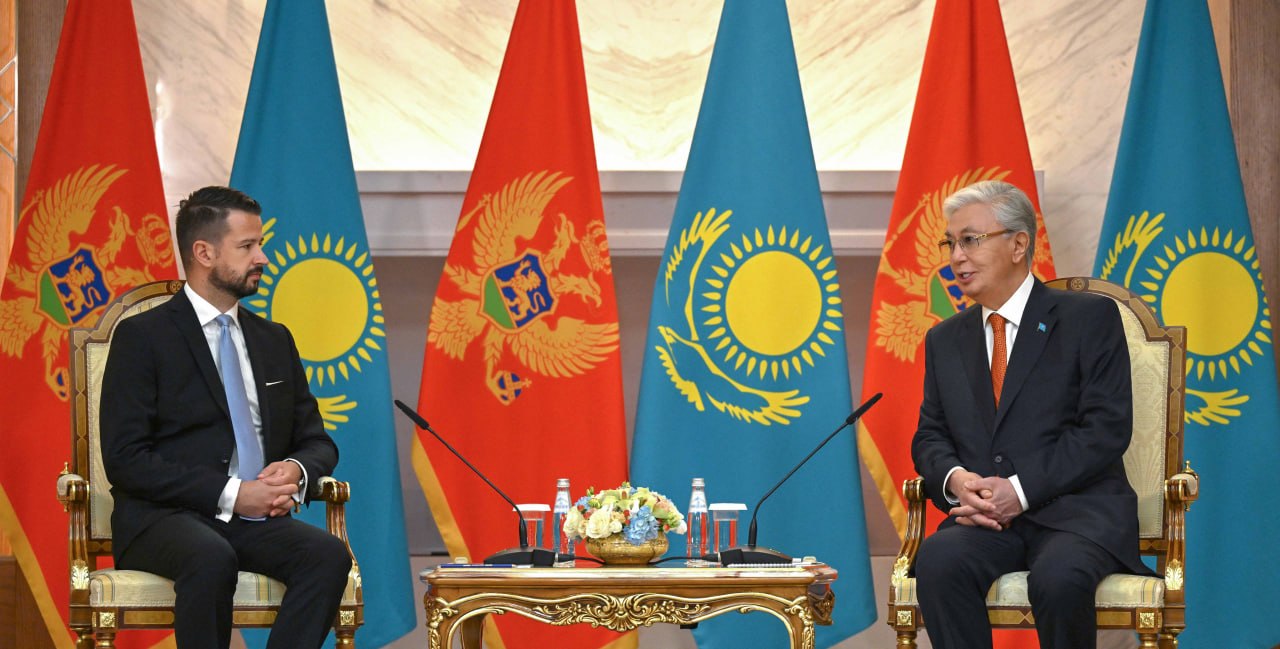

BAKU, Azerbaijan, June 22. The official visit of Montenegrin President Jakov Milatovic to Kazakhstan on June 18–20, 2026 marked the first visit by the head of this state in the history of bilateral relations. The event reflects the expansion of Kazakhstan’s European direction of external contacts.
Until recently, Astana’s European agenda was mainly focused on the large economies of Western Europe – primarily Germany and France – as well as several Central European countries, including Hungary. The intensification of contacts with Balkan countries appears to indicate Astana’s intention to diversify the geography of its engagement.
Although economic relations between Astana and Podgorica remain limited (trade turnover amounted to only $256.5 million in January-April 2026, according to the Bureau of National Statistics of Kazakhstan), the partnership has significant potential. Montenegro is in the final stage of negotiations on accession to the European Union and aims to become a full EU member by 2028. Montenegro could act as a kind of intermediary, facilitating more effective integration of Kazakhstan into the European legal and economic space.
During the talks between the presidents of Montenegro and Kazakhstan on June 19, the sides discussed expanding cooperation in transport and logistics, agriculture, and digitalization. They also considered issues related to increasing mutual trade and developing business ties, including through a memorandum between the chambers of commerce of the two countries.
The Kazakh side stated its readiness to create conditions for Montenegrin companies to enter its market. An additional dimension of cooperation is taking shape in the humanitarian and tourism sectors. A visa-free regime, in effect from May 1 to October 1, as well as interest from Kazakh tourists, makes Montenegro a notable destination in the Balkans, potentially contributing to the development of air connectivity and the services sector.
Special attention is paid to the environmental agenda. Montenegro positions itself as an ecological state, even enshrining this status at the constitutional level, while Kazakhstan declares a course toward decarbonization of its economy. According to the Ministry of Energy, Kazakhstan plans to commission more than 8 GW of renewable energy capacity by 2035. However, in practice, this still represents more of a coincidence of goals than a fully developed area of cooperation. At the same time, the similarity of strategic priorities creates potential for expanding cooperation in green energy, ecological tourism, and exchange of experience in sustainable development.
Overall, the visit can be seen as an example of Kazakhstan expanding its contacts in Europe through smaller and more flexible countries that can serve as linking points in broader European processes. It also reflects the gradual emergence of the Balkans as a new direction in Kazakhstan’s European policy. Among recent high-level contacts with Balkan countries in Kazakhstan, one can note the visits of the presidents of North Macedonia and Bulgaria in 2025, as well as the president of Serbia in February 2026. In the medium term, the success of the Astana-Podgorica partnership will depend on the ability of both sides to move from general statements to concrete projects. For Kazakhstan, this may also become useful experience in developing relations with the European Union, where Montenegro may in the future take its full-fledged place.



