


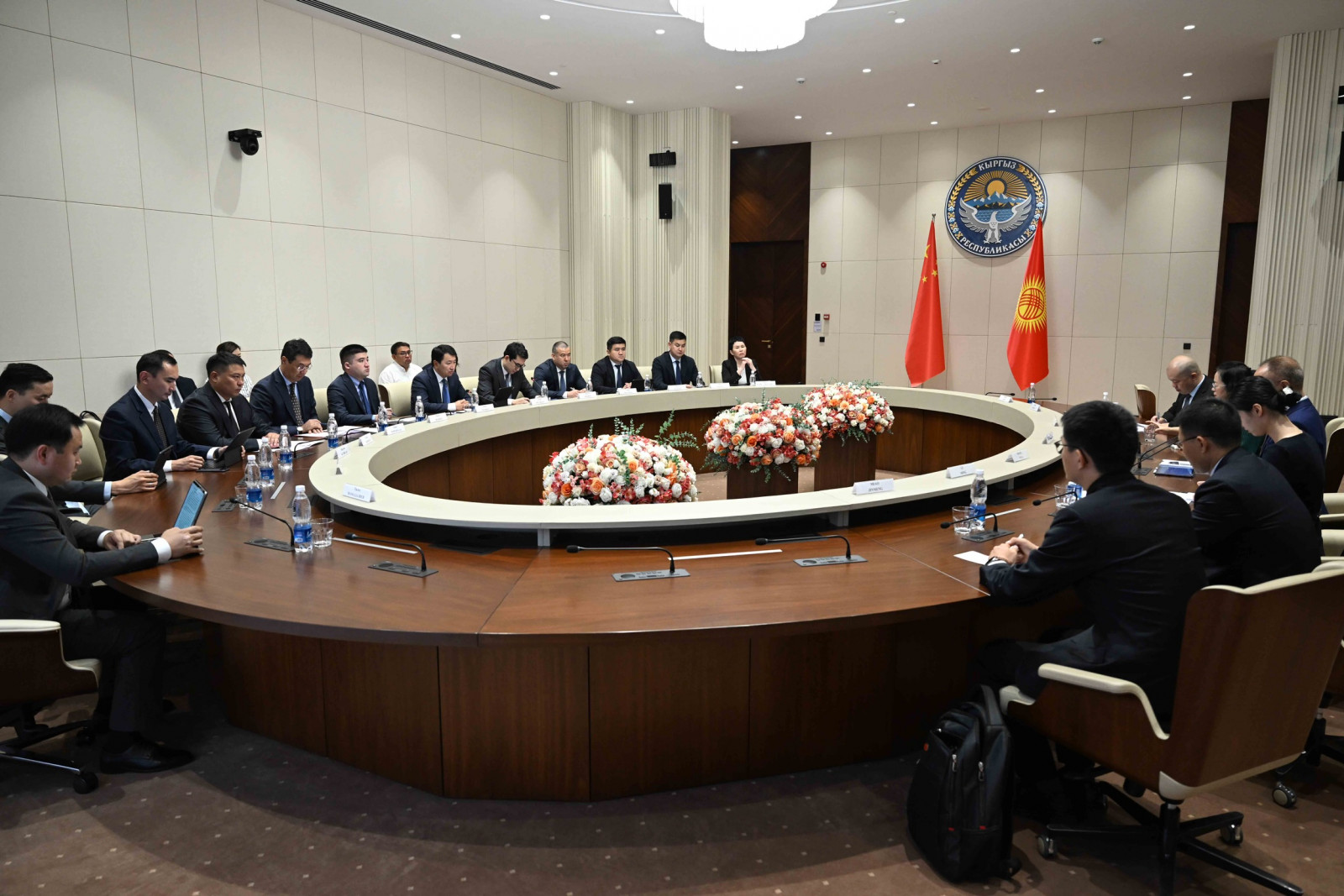

BAKU, Azerbaijan, July 17. Deputy Chairman of the Cabinet of Ministers of Kyrgyzstan Erlist Akunbekov and Chairman of the China International Development Cooperation Agency (CIDCA) Chen Xiaodong discussed the further development of bilateral trade and economic cooperation and the implementation of joint projects.
The talks provided further evidence that cooperation between Bishkek and Beijing is expanding beyond individual infrastructure initiatives and increasingly covering a broad range of sectors, from transport and industry to agriculture, energy and logistics.
According to the Kyrgyz side, bilateral trade reached $27 billion last year. At the same time, construction of the China–Kyrgyzstan–Uzbekistan railway continues, the Bedel border crossing has been opened, work is underway on the Bedel–Barskoon highway, and 11 major joint projects are being implemented in agriculture, healthcare, transport and customs infrastructure, environmental protection and technical modernization.
The expanding agenda suggests that bilateral cooperation is becoming increasingly comprehensive. While only a few years ago the focus was primarily on trade and border infrastructure, the partnership is now increasingly extending to industrial cooperation, investment and the creation of new export opportunities.
The China–Kyrgyzstan–Uzbekistan railway remains the most significant project. Construction entered an active phase in 2026. The key international and investment agreements have been signed, the general contractor has been appointed, financing has been secured, and construction of tunnels, bridges and other infrastructure is underway. At the same time, Kyrgyzstan and China continue to coordinate the implementation of the project, while Uzbekistan has confirmed that construction is progressing in line with the approved schedule.
For Bishkek, the railway represents far more than the construction of a new transport link. The route, stretching approximately 480 kilometers, with more than 304 kilometers running through Kyrgyzstan, is expected to significantly strengthen the country's role as a regional transit hub. The corridor is designed to connect China's transport network with Central Asia and further with routes leading to the Caspian region, Türkiye and Europe via the Middle Corridor, also known as the Trans-Caspian International Transport Route.
At the same time, the parties are discussing measures to improve the corridor's efficiency. China and Uzbekistan are considering granting the border railway station of Kashgar export station status, a move that could simplify cargo handling and accelerate customs clearance procedures. They have also agreed to establish a mechanism for regularly monitoring construction progress and maintaining coordination on logistics initiatives.
The expansion of transport infrastructure is being accompanied by broader business cooperation. In May 2026, Urumqi hosted the "Xinjiang (China) – Kyrgyz Republic" Investment and Foreign Trade Forum, where participants discussed new investment projects, industrial cooperation, logistics infrastructure and the expansion of bilateral trade. The Third Kyrgyzstan–Xinjiang Business Council meeting was also held, while the Chamber of Commerce and Industry of the Kyrgyz Republic officially opened its representative office in China's Xinjiang Uyghur Autonomous Region. The forum concluded with the signing of a number of cooperation memorandums between Kyrgyz and Chinese companies.
Industrial cooperation is also becoming increasingly prominent. During the Kyrgyz delegation's visit to China, discussions were held with energy giant Sinopec on potential joint ventures in oil and gas production and processing, as well as cooperation in renewable energy. In parallel, Chinese companies CIECC Planning and Design Research, Beijing Huafu Engineering and Shaanxi Construction New Energy are considering the construction of a mineral fertilizer plant in Kyrgyzstan.
Another example of expanding cooperation is the development of energy and logistics infrastructure. A joint Kyrgyz-Chinese project worth $430 million is being implemented in Kyrgyzstan's Osh region to facilitate coal exports from the Tekelik deposit through the Irkeshtam border crossing. The project includes the construction of a logistics complex in the village of Nura with two coal processing plants and a conveyor transport system. Its planned annual transportation capacity is expected to reach 10 million tons of coal.
Overall, bilateral cooperation is gradually expanding across interconnected sectors. The development of transport corridors is accompanied by the modernization of border infrastructure, the expansion of industrial projects, growing investment activity and the creation of new logistics routes. Such an approach could contribute to the development of more integrated production and trade chains, with infrastructure serving as the foundation for future industrial and export growth.
Another important step will be the upcoming meeting of the Kyrgyz-Chinese Intergovernmental Commission on Trade and Economic Cooperation, where the two sides plan to review ongoing projects in detail and prepare documents for signing during the forthcoming Shanghai Cooperation Organisation summit in Kyrgyzstan. The outcome of these discussions could shape the future direction of bilateral cooperation in the coming years.
Several scenarios are possible for the further development of Kyrgyzstan-China relations. If current implementation rates are maintained, the two countries could expand cooperation through new investments in transport, industry, energy and agriculture, while increasing bilateral trade and transit volumes. Industrial cooperation may also deepen through the establishment of joint manufacturing facilities and the development of logistics centers linked to the China–Kyrgyzstan–Uzbekistan railway.
Another possible scenario is that both sides prioritize the completion of projects already underway, while the launch of new initiatives depends on the effectiveness of financing mechanisms, the pace of infrastructure construction, the readiness of supporting logistics networks and broader trends in regional trade. Further integration of Central Asian transport routes may also be accompanied by new joint projects in border infrastructure, customs digitalization and the development of multimodal transport.



