


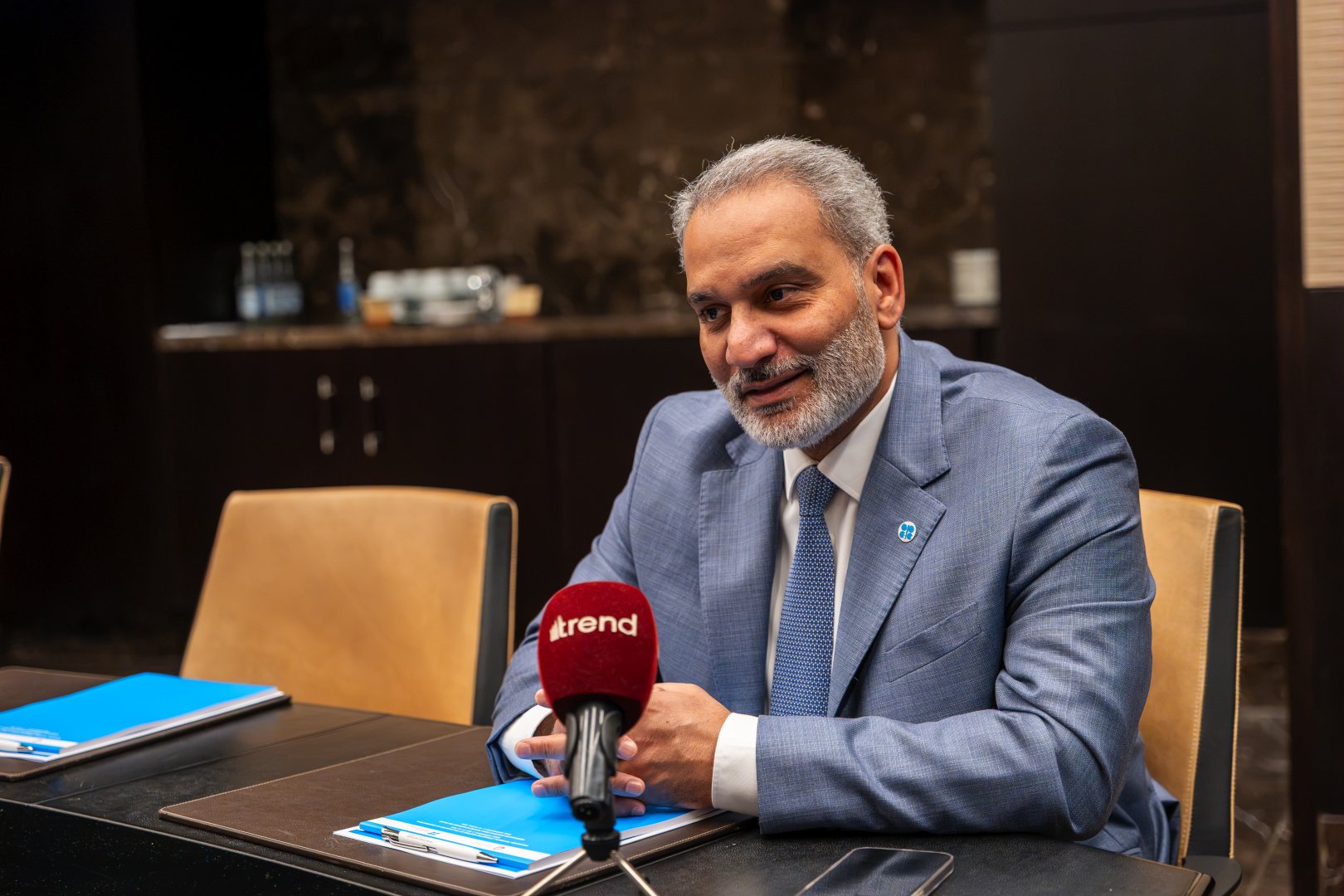

BAKU, Azerbaijan, July 15. The credibility and the trustworthiness of OPEC producers, especially in the Gulf, should not be questioned by anybody, Secretary General of the Organization of the Petroleum Exporting Countries (OPEC) Haitham Al Ghais said in an exclusive interview with Trend.
He made the remarks on the sidelines of the inaugural Technical Committee Meeting of the OPEC+ Charter of Cooperation in Baku.
"In December 2026, OPEC+ will become 10 years old. I believe it's a very big milestone for us as a group of producers. The Declaration of Cooperation was created in 2016, and Azerbaijan is a valuable player in this alliance. Building on the success of 10 years, it's important for us to be able to show that this group is, first of all, united. We have been together through many challenges. In 2016, we had the big downturn in the oil industry, then COVID-19 in 2020 what ensued after that in the market. So, we have been tested and proven as a solid group, a unified group that is capable of meeting all these significant market challenges. We feel that there is also a broader scope for widening this cooperation between this group of countries and producers into areas that are beyond just market stability”, he said.
Haitham Al Ghais believes that there are many different strengths and capabilities within each individual country that is in the OPEC+ alliance that allows to build on areas of cooperation that were not foreseen in the beginning, for example, coordination of positions for various different international fora such as climate change, technology transfer, knowledge sharing, training, doing joint studies, joint ventures between countries.
"All of these areas have been untapped with 22 different countries in this alliance. There is much bigger scope for furthering and broadening this cooperation. That's why I think it's important to say why we are in Baku. Baku has been the first place for so many different things related to the oil industry. Whether it's the first oil well in Bibi-Heybat, which is still producing, or the first industrial modern oil ship. This is why we decided to have the first technical level meeting here in Baku, building on the good spirit of having many firsts here that have been tested to last for hundreds of years. He also praised the kind invitation by the government of Azerbaijan to host this meeting in Baku," said OPEC's secretary general.
He praised Azerbaijan's role in strengthening the cooperation among OPEC+ members.
"I have been coming here every year. Part of the reason why I come here is to express OPEC's appreciation and gratitude to the leadership and government”. Of course, under the wise and able leadership of the President Ilham Aliyev, Azerbaijan has been instrumental in promoting and supporting the cooperation between OPEC+ producers for ten years now. Of course, with his able lieutenant, if I may use that term, the Minister of Energy, my brother Parviz Shahbazov, and his team have also been instrumental and highly valuable in this process. They have played a key role in energy diplomacy and consensus-building, which is absolutely critical given the diversity of our alliance, bringing together nearly 22 countries. So, Azerbaijan's role has been absolutely critical, and we truly appreciate that. That's why I come here year after year and express gratitude to this country," noted Haitham Al Ghais.
Balance between market stability and demand uncertainty
He pointed out that balance between market stability and demand uncertainty is one of the things where OPEC always takes a very cautionary approach.
"We have always been able to navigate these difficult times of uncertainty, because we don't react to headline news. We are very cautious in our approach, in our analysis, and the detailed level of analysis that my colleagues undertake at the Secretariat in OPEC. That's why we do not add to the volatility that is in the market because of so many different diverging views on demand. Unfortunately, there are many analysts out there who just react to a headline about a certain event, be it geopolitical, or economical. That's not the way that proper analysis should be done. At OPEC, our research team is focused on the solid data on the ground. We take a cautious approach, ensuring that we do not overreact or take unnecessary measures that may later require adjustments, as has happened with others. This makes us unique in our approach because our objective is to reduce the volatility in the market and not add to that volatility by overreacting or reacting in an unnecessary way when there is no need to," added OPEC's secretary general.
OPEC+ response mechanisms in times of supply disruptions
As for the instruments to respond quickly to major supply disruptions, Haitham Al Ghais highlighted two main factors.
"Firstly, whether it's the current circumstances or any other circumstances, we have several major OPEC producers that have invested over many years to be able to be in a position where they can react for any sudden market situation like we have seen. For example, our biggest producer, the Kingdom of Saudi Arabia, has the East-West pipeline, which has come in very useful at these current times where significant volumes of crude oil have been moved from the eastern route to the western, to the Red Sea. Other countries also have other pipeline capabilities. Countries have overseas storage. There are many other potential routes for ensuring the stability of supplies and the continuous flow of supplies during such times. That's the first thing I would say. Those measures have been tested, they have been very effective in reducing the shortages of supplies that the market has been witnessing," he said.
OPEC's secretary general also pointed out that the credibility and the trustworthiness of OPEC producers, especially in the Gulf, should not be questioned by anybody.
"We have recently seen, unfortunately, the executive director of the International Energy Agency recently coming out and using terms about the lack of trustworthiness of the straits, or that some of the producers have to rebuild trust. I think that is both unfair, wrong, and not helpful. We have done everything we can to make sure that the world has sufficient and adequate supplies. The market has adjusted in many different ways. But questioning the reliability and trustworthiness of producers in the Gulf — where we have been among the most reliable producers for decades — is, in my view, not helpful. Incidents happen, wars happen, things that are beyond our control happen. By the same token, if I want to argue, we had World War II in Europe from 1939 to 1945. Nobody came and said we should not have trust in the European manufacturing or the European industries, for example. I think the worst thing that could happen at this stage is to promote the narrative that Gulf producers cannot be trusted, or that oil as a commodity cannot be relied upon. That is counterproductive and not useful to the global economy. We urge people to take those comments with extreme caution," he added.
Role of oil in long-term energy security amid energy transition
Haitham Al Ghais said OPEC's message has always been that oil will remain a fundamental aspect and a fundamental pillar to the global economy.
"It has been for so many years and decades, and it will continue to be. We just launched our updated World Oil Outlook to 2050, which shows clearly that oil will still remain dominant in the energy mix until 2050, at around 30% of the energy mix. When you add gas to that equation, we are talking about oil and gas combined accounting for nearly 55% of the global energy mix. Again, this brings me back to the point I said about all these people talking about energy transition for many years, almost equating energy transition with abandoning oil and gas. We at OPEC talk about energy transitions and energy addition, because energy consumption in the world will grow at such a significant rate. We believe it will grow by around 23% from now to 2050. Of course, oil will be a major component of that. In addition to the growth we will see in renewables, we will see growth in gas. But it should not be interpreted as if this will replace oil and gas. We see the only source of energy that will be on the decline is coal due to climate and environmental concerns. That's why we at OPEC believe in the importance of continuing to invest in oil and in gas, and as well in renewables," said OPEC's secretary general.
Noting that not all of OPEC member countries are investing in all sources of energy, he said OPEC doesn't target or exclude any form of energy under the name of climate change or trying to deal with climate matters.
'The whole Paris Agreement is actually centered on dealing with emissions from all sources, not just from oil and gas. So again, we caution against using the energy transition as a means to pushing for another agenda, which is abandoning oil and gas. It should not be the case. Oil is fundamental. You see it in every single aspect of our daily lives, be it transportation, clothing, flights, shipping, packaging, sports equipment. Since we're talking about the World Cup these days, everything you see, even the football they play with is made of petrochemical derivatives. It is in every aspect in our daily lives that people cannot even imagine. That's why it's important to support this commodity, to make sure that it's a stable commodity, because it impacts the daily lives of people all around and the livelihood of people. That's what we try to do through the OPEC+ cooperation, making sure that we have a stable market to support the global economy through this oil, because 30% of global energy consumption is from oil," he explained.
OPEC’s perspective on oil prices and investment needs
Haitham Al Ghais recalled that OPEC does not comment on oil prices and doesn't even forecast the prices.
"I think the prices are a function of so many different elements, fundamentals and non-fundamental factors that we focus on the stability between the supply and the demand. That's what we do through the Declaration of Cooperation and we have been doing it successfully. Now, we can talk about what levels of investment are needed. According to our outlook, we need almost $700 billion per year to sustain the oil industry. That means from now to 2050, almost $18 trillion in total. That covers the upstream, downstream and midstream industry. That's significant, and that's what we try to promote through making sure that the market is stable, that there is an investor-friendly appetite. We have seen that declining, of course, over the years when there is a big oversupply, and the environment is not conducive for investments. But also, I think, irrespective of the price, I'd like to circle that back to what we were talking about earlier regarding the narrative about abandoning oil and gas. The International Energy Agency said that 2030 is the end of the era of oil and gas. Yet every year, we are seeing a new record for oil demand. 2030 is less than five years from today. For the last 10 years, they have been forecasting that oil demand would peak and that it would be on the downward trend for the rest of the decade. But this is not happening. That is why it is important to focus not only on the price levels that enable and incentivize investment, but equally on the messaging that creates confidence in the future of the industry and encourages continued investment in oil and gas rather than discouraging it," OPEC's secretary general concluded.



