


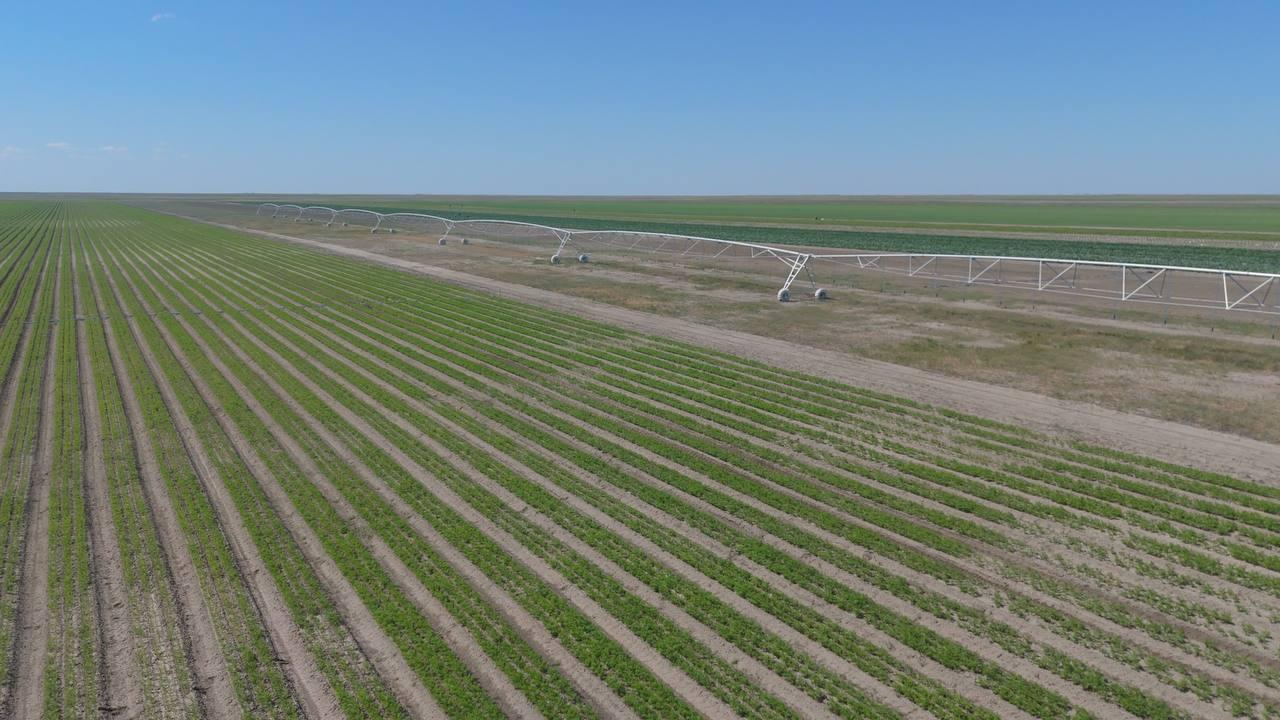

BAKU, Azerbaijan, July 16. Kazakhstan plans to commission around 1,000 kilometers of canals in 2026, improving water supply for approximately 200,000 hectares of irrigated land.
This was announced by the press service of the Kazakh government, citing remarks by Minister of Water Resources and Irrigation Nurzhan Nurzhigitov at the meeting of the Water Council chaired by Prime Minister Olzhas Bektenov.
''A total of 12 water supply construction and reconstruction projects are scheduled to be commissioned this year. As a result, access to high-quality drinking water will be improved for 142 rural settlements with a combined population of more than 500,000 people,'' Nurzhigitov said.
According to him, in 2024–2025, Kazakhstan completed the reconstruction of five reservoirs in the Aktobe, Turkistan, West Kazakhstan, Abai, and Zhetysu regions. During the same period, around 1,500 kilometers of canals were repaired and modernized, while 22 drinking water infrastructure projects were completed, benefiting about one million people.
Furthermore, Nurzhigitov stated that the adoption of water-saving technologies in agriculture increased nearly fivefold by the end of 2025. The area using such technologies expanded to around 550,000 hectares, saving approximately 880 million cubic meters of irrigation water. The government aims to increase this figure to 1.3 million hectares by 2030.
The minister added that work is currently underway to construct and reconstruct reservoirs, modernize 14,500 kilometers of irrigation canals, including the digitalization of at least 3,500 kilometers of canals, expand the use of water-saving technologies, accelerate the sector's digital transformation, and strengthen human resources.
Moreover, it was also noted that efforts are continuing to address workforce shortages and improve the attractiveness of careers in the water sector. The network of educational institutions training water specialists has been expanded, while the number of state-funded scholarships continues to grow. Since 2023, a total of 1,652 educational grants have been allocated, with another 1,000 grants planned for the upcoming academic year.
The minister added that salaries have also been increased to attract and retain qualified personnel. Over the past two and a half years, the average salary of employees at the state-owned enterprise Kazvodkhoz has more than doubled.
Meanwhile, a source from the Eurasian Development Bank’s (EDB) Analytical Department told Trend that a pilot project in Kazakhstan testing modern irrigation technologies is providing a blueprint for a potential regional industry in Central Asia.
"The EDB’s $5.3 million grant project with UNDP and Kazakhstan’s Ministry of Water Resources and Irrigation will start in Kazakhstan’s southern and eastern agricultural regions, where water stress is acute - including Almaty, Zhambyl, Kyzylorda, Turkestan, and Zhetysu regions, with particular focus on Turkestan and Kyzylorda. These are the areas where the impact of modern irrigation technologies can be measured quickly and visibly," the source stated.
The initiative establishes demonstration sites for modern irrigation systems - plastic pipelines and drip solutions - allowing the Bank and its partners to test technologies, adapt them to local conditions, and assess practical performance. At least 180 specialists will be trained, creating the skilled workforce needed for regional deployment.
"This makes the project a practical proof of concept for future regional production. It will show which technologies work best in local conditions, what technical standards are required, what skills farmers and water-sector specialists need, and how equipment can be installed, operated, and serviced at scale," the source explained.



