



ALMATY, Kazakhstan, June 25. The Trans-Caspian Green Corridor could emerge as a long-term strategic route for exporting surplus electricity generated from renewable energy sources (RES), Sergey Tulinov, Project Manager at the Secretariat of the United Nations Economic and Social Commission for Asia and the Pacific (ESCAP), said, Trend's special correspondent reports from the event.
He made the remarks during a presentation of analytical reports held as part of the Eurasian Development Bank’s Annual Meeting and Business Forum.
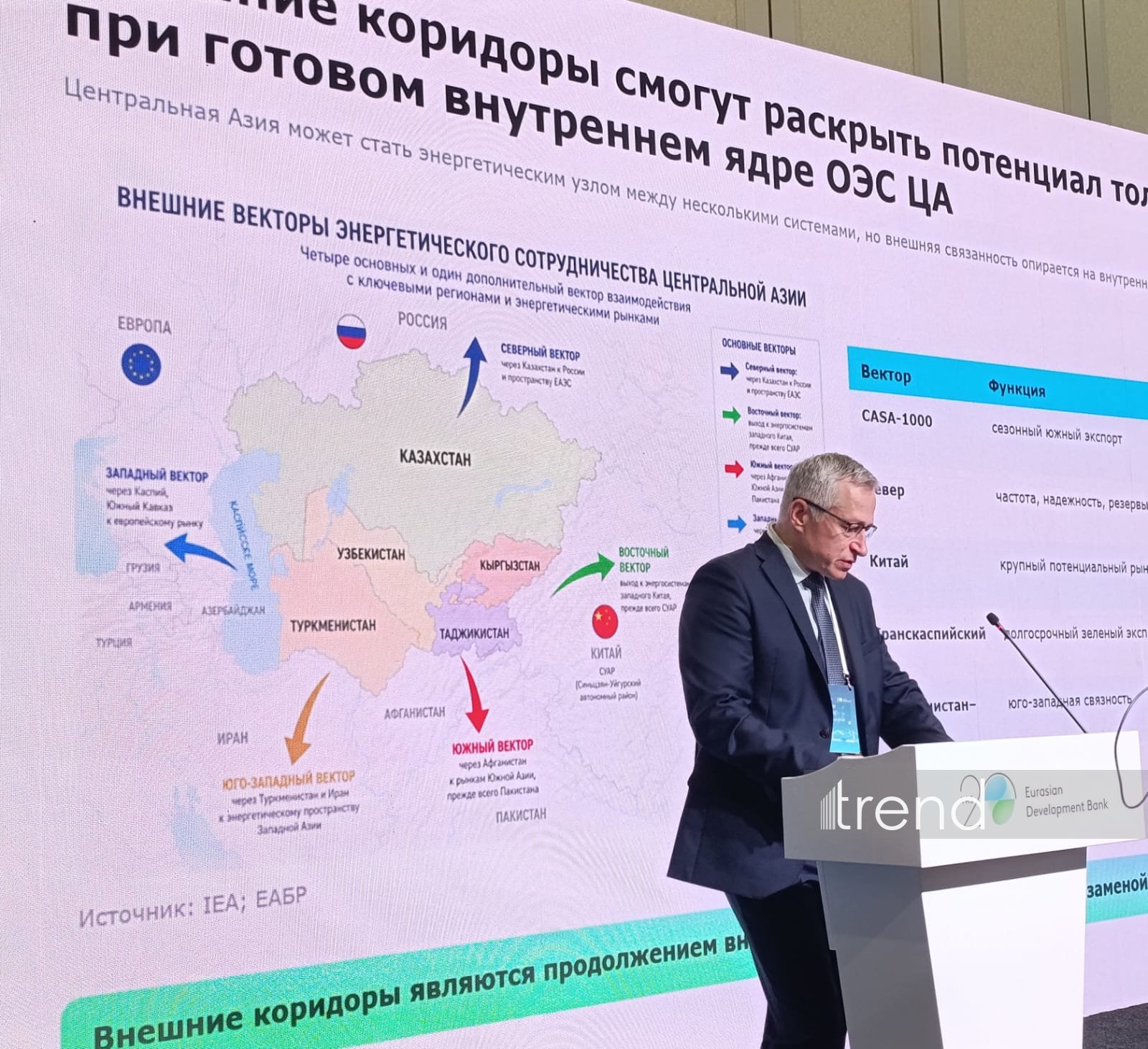
He said Central Asia could evolve into an energy hub connecting several regional power systems.
“The CASA-1000 project opens a southern corridor for exporting hydropower to Pakistan and, in the longer term, to India via Afghanistan. The northern corridor through Russia is important for maintaining the stability of interconnected power systems. There is also potential here for expansion and mutually beneficial cooperation,” he said.
Tulinov noted that China represents a major potential market, while the Trans-Caspian Green Corridor could serve as a long-term strategic route for exporting surplus renewable electricity.
He added that each of these routes is relevant for expanding electricity trade in the future. However, external corridors cannot replace internal integration.
On the contrary, he stressed that their sustainability depends on how cohesive and integrated Central Asia’s internal power system becomes, both technologically and institutionally.
He recalled that at COP29 last year, Azerbaijan, Kazakhstan and Uzbekistan signed an intergovernmental agreement on strategic partnership for the development and transmission of green energy. To implement the agreement, the Green Corridor Alliance LLC was established.
The feasibility study for the project is being carried out by Italy’s CESI S.p.A.



