


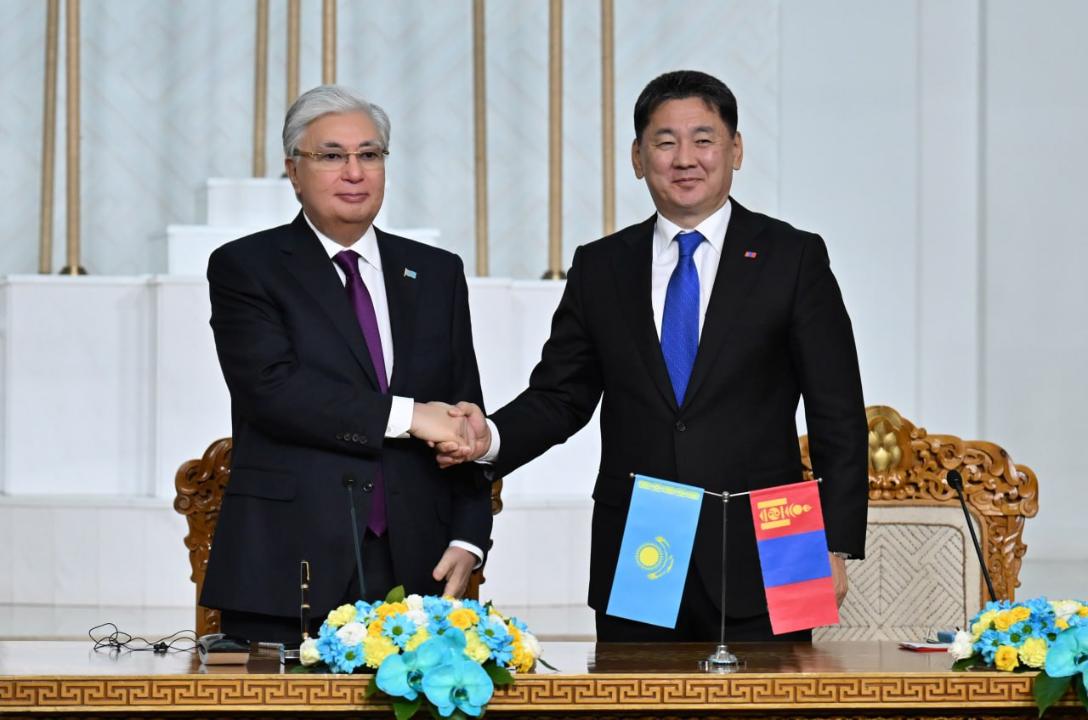

BAKU, Azerbaijan, April 20. At the invitation of President of Kazakhstan Kassym-Jomart Tokayev, President of Mongolia Ukhnaagiin Khurelsukh will pay a state visit to the country on April 20-23, 2026. High-level talks are expected to provide additional momentum to the already established strategic partnership.
In recent years, cooperation between Kazakhstan and Mongolia has significantly intensified. A turning point came with Tokayev’s visit to Ulaanbaatar in October, 2024, following which the Joint Declaration on the Establishment of a Strategic Partnership was signed. At the same time, the sides concluded 11 agreements across various sectors, ranging from transport and agriculture to digitalization, energy, and culture.
Economic cooperation is also gaining pace. In 2025, bilateral trade exceeded $133 million, almost tripling compared to previous years. Kazakh exports accounted for $123 million, with more than 90% of shipments consisting not of raw materials but of finished goods, including food products, industrial goods, and other commodities. Both sides have set a broader target of increasing trade turnover to $500 million. To this end, a 2025–2027 Road Map is being implemented, aimed at expanding the range of goods and reducing trade barriers. Additional opportunities may emerge from a temporary trade agreement between the EAEU and Mongolia, covering around 367 tariff lines. Its implementation is expected to facilitate market access and further strengthen economic ties, indicating a gradual shift toward a more stable and systemic partnership.
Growing business engagement further confirms this trend. In March 2026, Kazakhstan sent a business mission to Mongolia for the first time in seven years. As a result, export contracts worth $62.6 million were signed in Ulaanbaatar.
Particular attention is being paid to transport and logistics. For both Kazakhstan and Mongolia, which are landlocked countries, this is not only an economic issue but a strategic priority. Kazakhstan offers its transit potential to facilitate Mongolia’s access to the EAEU, the Caucasus, Türkiye, and the European Union markets, including through the Trans-Caspian International Transport Route (Middle Corridor).
Additionally, Ulaanbaatar and Astana are discussing a shortened road transport route via Ust-Kamenogorsk, Ridder, and the Russian settlement of Tuekta. If implemented, the route length could be reduced from 1,604 km to approximately 837 km. The 189 km Kazakh section has already been constructed, while part of the road is planned for reconstruction. This would significantly reduce delivery times and logistics costs.
Another practical step is the launch, starting June 2, 2026, of direct flights on the “Astana - Ulaanbaatar - Astana” route, to be operated by SCAT Airlines. This is expected to facilitate business contacts and expand humanitarian ties.
At the same time, the broader geopolitical context remains important. For a long time, Mongolia’s foreign economic relations were largely oriented toward Russia and China. However, Ulaanbaatar is now gradually seeking to diversify its external partnerships, with Kazakhstan emerging as one of its key partners in this process.
In addition, Tokayev supports the initiative to establish a “Trans-Altai Dialogue,” which would bring together Kazakhstan, Russia, China, and Mongolia. The initiative focuses on improving transport connectivity and deepening economic cooperation across this macro-region.
The upcoming visit of President Khurelsukh to Kazakhstan is expected to consolidate previously reached agreements and translate cooperation into a more practical framework. The main focus is likely to be on implementing existing agreements, expanding trade, and launching new logistics projects.
Overall, Kazakhstan–Mongolia relations are gradually moving from political declarations toward substantive economic content. If current dynamics continue, the goal of increasing trade turnover to $500 million appears achievable in the medium term.



