


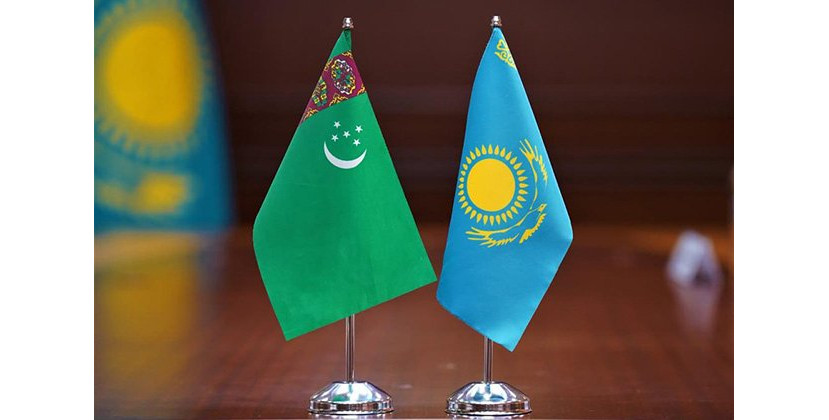

BAKU, Azerbaijan, June 26. June 24 saw the 14th meeting of the Kazakhstan-Turkmenistan Intergovernmental Commission on Economic, Scientific, Technical and Cultural Cooperation take place in Astana. During the meeting, the parties discussed prospects for cooperation in trade, transport, logistics, industry, energy and investment. Following the talks, Kazakhstan and Turkmenistan reaffirmed their interest in further increasing bilateral trade, developing transport and transit cooperation, and expanding business ties between enterprises of the two countries, identifying a number of areas for deepening economic partnership.
The economic dimension was one of the central themes of the meeting for a reason. As participants noted, trade turnover between Kazakhstan and Turkmenistan has doubled over the past five years. However, these figures reflect a broader process. In recent months, Turkmenistan has effectively entered a new investment cycle: in April, the country launched the fourth phase of development of the Galkynysh gas field together with China's state-owned energy company CNPC, and in June signed a new production sharing agreement with Malaysia’s PETRONAS on Caspian oil projects. The implementation of these initiatives is expected to attract investment, expand production activity, and generate additional demand for goods, services and logistics solutions. As a result, the additional financial flows could create a multiplier effect for both local companies and foreign businesses operating in the country.
As Trend previously noted in its article “Inside Turkmenistan’s investment cycle: How Turkish contractors anchor a new phase of economic expansion,” China, the United States, Türkiye and several European countries have in recent months demonstrated growing interest in expanding cooperation with Turkmenistan. Kazakhstan is acting within the same trend, seeking to strengthen the position of its businesses in a market that could receive an additional boost in the coming years from large-scale energy, infrastructure and industrial projects. This largely explains the increased attention paid by the two sides to trade and economic cooperation during the intergovernmental commission meeting.
Transport, in turn, occupies a special place in relations between Kazakhstan and Turkmenistan. In a joint statement issued by Presidents Kassym-Jomart Tokayev and Serdar Berdimuhamedov in October 2022, the parties confirmed their intention to develop the China-Kazakhstan-Turkmenistan-Iran transport corridor, as well as the Uzen-Gyzylgaya-Bereket-Etrek-Gorgan railway route, describing it as one of the priority directions for cargo transit through the territories of the two countries.
In the years that followed, the transport agenda gained additional momentum. Kazakhstan has consistently advocated the expansion of international transport routes using Caspian infrastructure, while President Tokayev previously emphasized that the development of port infrastructure in Turkmenistan and Iran could significantly expand the export geography of regional countries and strengthen their logistics capabilities.
A similar approach can be observed in Ashgabat. In September last year, President Serdar Berdimuhamedov described the further development of the North-South and East-West transport corridors as one of the country's priority tasks, stressing the need to make fuller use of Turkmenistan’s international transport and transit potential. At the same time, international organizations also view Turkmenistan as one of the key elements of Eurasia’s transport architecture. In particular, the Economic Cooperation Organization has announced plans for further integration of transit routes passing through the country into broader regional transport networks.
Against this backdrop, discussions on transport and logistics cooperation during the intergovernmental commission meeting appear to be a logical continuation of the policies that Astana and Ashgabat have pursued consistently in recent years. Amid growing uncertainty surrounding traditional routes through the Middle East, transport links between Kazakhstan and Turkmenistan are becoming increasingly important, transforming from a tool of bilateral trade into an element of a broader regional logistics strategy.
One of the most illustrative examples is Belarus, which launched an accelerated container rail service to Iran late last year via the Belarus-Russia-Kazakhstan-Turkmenistan-Iran route. The new service, organized by Beltamozhservice, provides cargo delivery within 13–15 days and is aimed at expanding trade between Belarusian producers and markets in the Middle East and Asia.
At the same time, this route is not an isolated project. Earlier, shipments of Belarusian potash fertilizers were organized through Kazakhstan and Turkmenistan toward Iran and onward to China via the eastern branch of the International North-South Transport Corridor (INSTC). According to the Transport and Logistics Center of Turkmenistan, the cargo moved through Belarus, Russia, Kazakhstan, Turkmenistan and Iran before being shipped by sea to Asian ports.
Such experience is particularly relevant amid ongoing uncertainty surrounding traditional southern routes. The conflict involving Iran has already demonstrated the vulnerability of logistics chains dependent on a limited number of transit corridors. This is especially important for Turkmenistan, as Iran remains one of its largest trading partners and a key gateway to the ports of the Persian Gulf and the Indian Ocean.
Under these circumstances, the importance of alternative and duplicate routes capable of ensuring supply-chain resilience in the event of external disruptions is increasing. This is why the Kazakhstan-Turkmenistan-Iran corridor and the transport routes passing through Turkmenistan are increasingly viewed not only as instruments for expanding trade but also as elements of regional logistics security.
In this context, the 14th meeting of the Kazakhstan-Turkmenistan Intergovernmental Commission appears to be more than just another bilateral gathering; it reflects broader processes unfolding across the region. On the one hand, Kazakhstan is seeking to strengthen the position of its businesses in the Turkmen market at a time when Turkmenistan is entering a new investment cycle linked to major projects in energy, industry and infrastructure. On the other hand, both countries are interested in developing transport corridors whose importance has increased significantly amid changes in regional logistics and the growing need to ensure the resilience of trade routes. The combination of these factors largely explains the attention paid by both sides to business and logistics issues during the talks in Astana and allows their cooperation to be viewed as part of a broader process of building new economic connections across Eurasia.



