


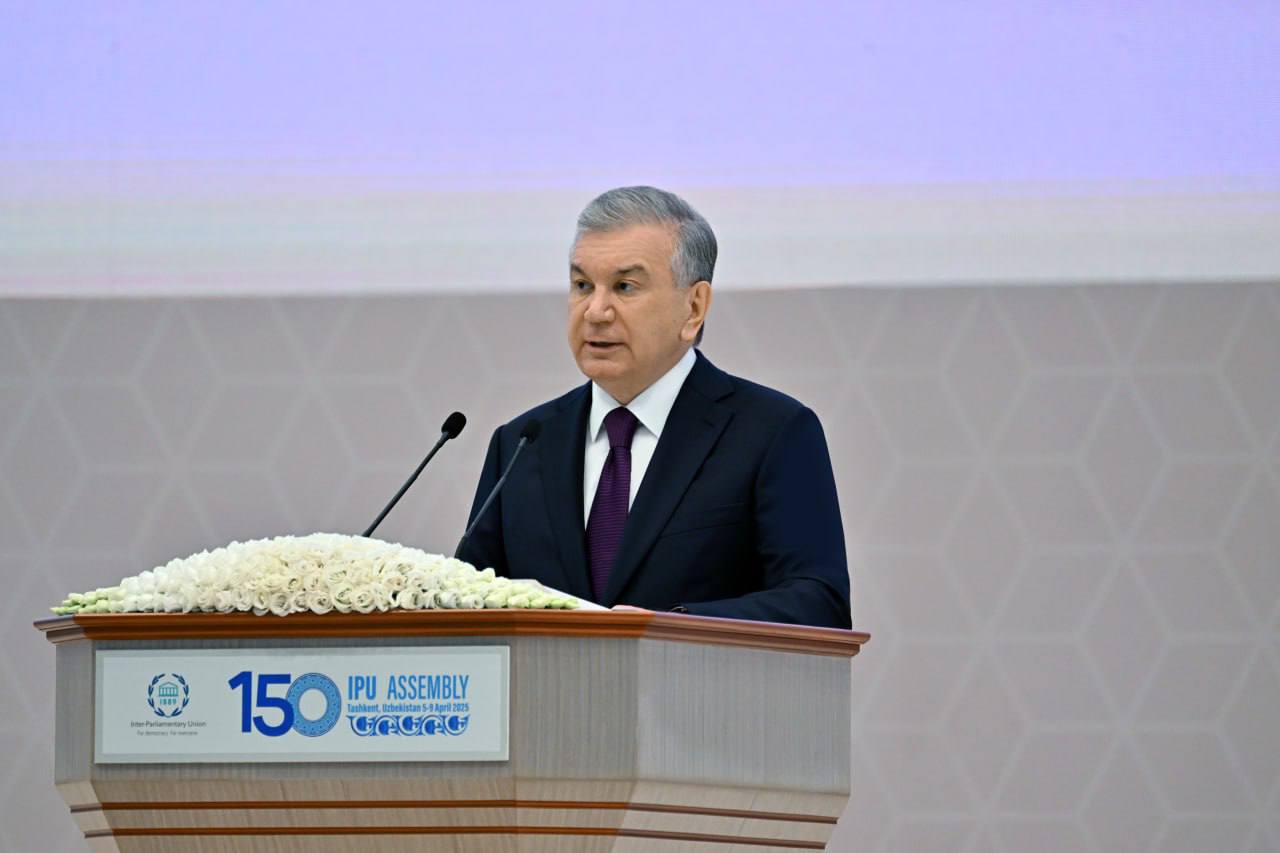
BAKU, Azerbaijan, May 18. The President of Uzbekistan, Shavkat Mirziyoyev, has proposed the creation of an international alliance of smart and safe cities to facilitate the systematic exchange of technologies, standards, and experience, Trend reports.
He announced this during his speech at the Leaders' Summit within the framework of WUF13 in Baku.
Full speech of President Shavkat Mirziyoyev:
Ladies and gentlemen,
I am very pleased to welcome all of you to the 13th session of the World Urban Forum — an authoritative platform for dialogue on the most pressing issues of global development.
I would like to express my sincere gratitude to the President of the Republic of Azerbaijan, distinguished Ilham Heydarovich Aliyev, for the excellent organization of today’s event in beautiful Baku — the ‘Pearl of the Caspian’ — and for the warm hospitality extended to us.
Large-scale reconstruction and development efforts are being carried out across Azerbaijan, especially in Karabakh, at an accelerated pace. Entire cities have been restored in a short period of time, while new residential complexes and modern infrastructure facilities are being built in the liberated territories.
Taking this opportunity, I would like to emphasize that Uzbekistan is always ready to contribute to this noble cause.
Distinguished forum participants,
The theme of our agenda today — ‘Housing for All: Safe and Sustainable Cities and Communities’ — is becoming increasingly relevant. According to current analysis, by the middle of the 21st century nearly 70 percent of the world’s population will live in cities.
At the same time, the growing process of urbanization is intensifying a number of social problems.
Today, nearly three billion people worldwide lack adequate housing conditions. More than one billion of them live in informal settlements and slums, while over 300 million people have no shelter at all. Climate change, tense international conditions, and economic crises are creating new waves of global migration, leading to population redistribution among countries and cities. Simply put, urbanization processes are becoming a serious factor directly affecting global stability and security.
All of this requires decisive and urgent action from all of us.
Dear friends,
For New Uzbekistan, the issue of sustainable urban development is also of strategic importance. Over the next 15 years, the country’s population is expected to grow from 38 million to 50 million people, while the urbanization rate is projected to increase from 51 to 65 percent. We see this as a unique opportunity for balanced regional development and sustainable economic growth.
To this end, Uzbekistan has increased the annual volume of housing construction tenfold over the past decade. In 2025, the number of newly built housing units reached 238,000, and by 2030 this figure is expected to grow by another 1.5 times. Around $2 billion is allocated annually from the state budget for affordable housing programs. To address the issue of informal housing, a separate law was adopted in 2024, and documents for nearly 100,000 homes were legalized. As part of the renovation of outdated housing stock, we plan to increase the renovation rate from 15 percent to 60 percent.
To effectively manage these processes, a National Committee on Urbanization has been established.
In addition, within the framework of the ‘Yashil Makon’ (‘Green Space’) and ‘Toza Havo’ (‘Clean Air’) programs, we have set the goal of increasing urban green coverage to 30 percent by 2030.
In improving cities and enhancing the quality of life of the population, we rely extensively on the traditional system of citizens’ self-governance — the mahalla institution.
Ladies and gentlemen,
The mega-project ‘New Tashkent,’ designed for a population of two million people, has become a vivid embodiment of our urbanization strategy. This project fully incorporates the most advanced urban planning standards — the principles of a ‘green,’ ‘smart,’ ‘safe,’ and ‘15-minute’ city.
Already at the first stage, we have launched investment projects here worth more than $25 billion in total.
A presentation of the ‘New Tashkent’ project concept has been organized at the Urban Expo exhibition taking place within the framework of the forum.
Most importantly, similar projects under the name ‘New Uzbekistan’ are being implemented not only in the capital, but across all regions of the country. To date, 61 such residential areas have already been built, and by 2030 their number will reach 100.
In this regard, I would like to express my sincere gratitude to the Executive Director of the United Nations Human Settlements Programme, Ms. Anacláudia Rossbach, as well as to the World Bank, the Asian Development Bank, and other leading financial institutions for their close cooperation with us in the fields of urbanization and urban planning.
Distinguished forum participants,
I would like to put forward several important proposals and initiatives regarding the issues under discussion today.
First, creating equal living conditions for people in all regions requires the harmonious development of small and medium-sized cities.
In this regard, I call on partner states to widely implement the principle of ‘balanced urbanization’ in urban development.
Second, it is necessary to ensure that all countries have equal access to artificial intelligence and digital transformation in urban governance.
I propose establishing an international ‘Alliance of Smart and Safe Cities’ for the systematic exchange of technologies, standards, and experience in this field.
Third, it is extremely important to provide young people and vulnerable groups with quality and affordable housing.
For this purpose, we are ready to host an international forum in Samarkand next year dedicated to new approaches for attracting financing and investment in housing construction.
Fourth, given the global climate changes, it is essential to adopt common principles and standards for the development of green cities.
In order to encourage the development of cities in harmony with nature, I propose establishing the UN-Habitat international award ‘Green City.’
Fifth, the growth of urbanization further increases the role of traditional self-governance systems in cities.
In this regard, I propose holding the 15th session of the World Urban Forum in 2030 in New Tashkent under the main theme: ‘The Role of Local Communities in Sustainable Urban Development.’
Dear friends,
I am confident that today’s event will make a significant contribution to our joint search for mutually beneficial and forward-looking solutions to the issues under discussion, promote new initiatives, and support the further development of this sphere as a whole.
In conclusion, I would like to wish the forum every success in its work.



