


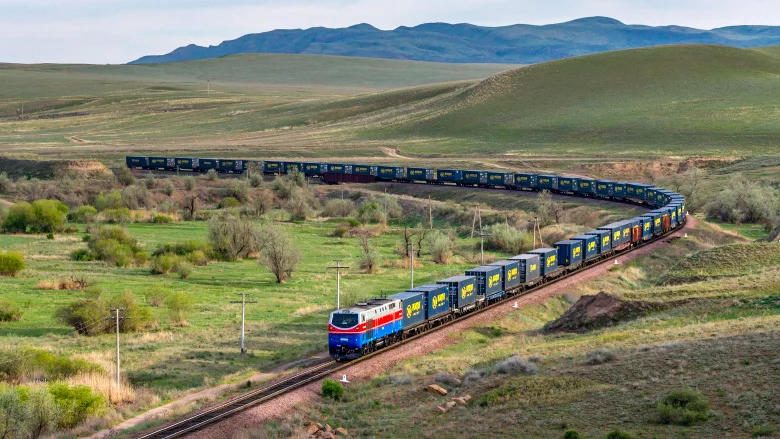

BAKU, Azerbaijan, July 18. The Middle Corridor should become not just a transport but also an economic route.
This was announced in an article by the President of PMCG consulting company, Aleksi Aleksishvili.
According to him, the Middle Corridor (Trans-Caspian International Transport Route) has a chance to become not only an alternative transport route linking Europe and Asia but also a fully-fledged economic corridor capable of attracting investment, fostering industrial development, and integrating the region into global supply chains,
"The rapid rise of the Middle Corridor has been driven by profound geopolitical and economic shifts, including the disruption of traditional trade routes following the COVID-19 pandemic, supply chain reconfiguration, and the consequences of Russia's war against Ukraine. These developments have significantly increased international interest in an alternative route connecting Europe and Asia through the South Caucasus and Central Asia.
Asia accounts for approximately 30-35 percent of global exports, while Europe represents around 35-40 percent of global imports. For decades, trade between the two regions has relied primarily on the Suez Canal and the Northern Route. However, rising geopolitical risks and supply chain vulnerabilities have prompted governments and businesses to seek more resilient trade corridors.
The author stressed that the key challenge today is not simply increasing cargo volumes but transforming the transport route into an economic corridor.
"Transport corridors move goods. Economic corridors create value. They attract investment, stimulate industrial development, support integration into global supply chains, and generate employment and prosperity.
The region has already made considerable progress, with trade among Central Asian economies expanding significantly over the past decade and commercial ties between Central Asia, China, Türkiye, the South Caucasus, and the European Union continuing to deepen.
Nevertheless, the Middle Corridor remains significantly underutilized. According to the article, it accounted for only around 1 percent of EU–China trade volume and approximately 5 percent of trade value in 2023, while its capacity remains below 10 percent of that of the Northern Route.
At the same time, World Bank projections suggest that trade along the corridor could increase by as much as 4.5 times by 2040 if operational and regulatory bottlenecks are addressed," he noted in the article.
Aleksishvili expressed the opinion that infrastructure development alone will not guarantee the corridor's success. He identifies differences in customs procedures, trade regimes, regulatory frameworks, and institutional capacities as major obstacles. In addition, only five of the eight countries along the corridor are members of the World Trade Organization, meaning a fully rules-based trading environment has yet to be established across the entire route.
"Another widely spread error is the perception of the Middle Corridor as a project of single countries. The corridor is only as competitive as its weakest link," he writes, emphasizing that its efficiency depends on the coordinated performance of all participating countries, ports, railways, border crossings, logistics operators, and institutions.
The sustainable development of the Middle Corridor is impossible without the active participation of the private sector. Along with public investments, the development of competitive logistics markets, access to trade finance, insurance instruments, and modern commercial institutions is also essential.
The importance of the Middle Corridor extends well beyond the countries it crosses, offering Europe and Asia a more diversified, resilient, and geopolitically balanced connection at a time when supply chain security has become a strategic priority.
The current momentum surrounding the Middle Corridor represents a rare opportunity. The challenge now is to move beyond infrastructure construction and focus on building institutions, harmonizing regulations, and strengthening regional cooperation. Only then can the Middle Corridor evolve from a transit route into a genuine economic corridor that generates long-term prosperity across Eurasia," the author concluded.
Earlier, the PMCG told Trend in an exclusive interview that Azerbaijan occupies one of the key strategic positions in the Middle Corridor not only due to its geographical location, but also due to its growing role in regional coordination, development of railway connectivity, and promotion of stability in the South Caucasus,
The company noted that, as an important transit country connecting Central Asia with the South Caucasus and further with Europe, Azerbaijan, together with Georgia, is a critical hub where sea and rail transport between the Caspian and Black Seas intersect.
"In this context, an effective link between the port of Baku on the Caspian Sea and the Georgian ports on the Black Sea, primarily Batumi and Poti, is of particular strategic importance. These ports serve as the main maritime gateways for cargo flows from the Middle Corridor to European markets, complementing land routes such as the Baku-Tbilisi-Kars railway. Recent positive developments in relations between Azerbaijan and Armenia have also improved the prospects for long-term stability and transport connectivity in the South Caucasus. Azerbaijan's constructive role in promoting regional cooperation is an important factor in the sustainable development of the Middle Corridor," PMCG noted.
The company stressed that close operational cooperation between Armenia, Azerbaijan, Georgia, and Türkiye remains the cornerstone of increasing capacity, synchronizing logistics operations, and reducing transit times.
"Increasing the capacity and security of the Middle Corridor requires a focus on developing multimodal transport and further modernizing infrastructure, especially between the Caspian and Black Seas. Additional investment is required in the railway infrastructure connecting Azerbaijan with Georgia's Black Sea ports, as well as in the development of port infrastructure. Equally important is greater private sector participation in rail freight transport and the strengthening of corporate governance in state-owned enterprises. Enhanced coordination between the transport ministries of Armenia, Azerbaijan, and Georgia, supported by digital platforms and unified procedures, will significantly improve the corridor's efficiency," PMCG said.
The company noted that the Middle Corridor creates significant opportunities for attracting foreign investment in port infrastructure, railway logistics hubs, and value-added services in supply chains.
"Growing international interest in supply chain diversification, including U.S. initiatives in the field of critical minerals and EU strategies for developing interconnectivity, further enhances Azerbaijan's investment attractiveness. PMCG plans to support the development of the Middle Corridor by conducting technical and economic studies, promoting regulatory policy reforms, building institutional capacity, and assisting in mobilizing international financing. The company intends to promote closer regional coordination and integrated planning between the Caspian and Black Sea segments of the corridor," PMCG added.
The Middle Corridor is a multimodal trade route connecting Asia and Europe through several countries in the region and serving as an alternative to the traditional Northern and Southern corridors. The route begins in China and passes through Central Asian countries before crossing the Caspian Sea, Azerbaijan, Georgia, and Türkiye, ultimately reaching Europe. It is a land-based transport route that bypasses longer maritime routes, linking the eastern parts of Asia, including China, with European markets.



