


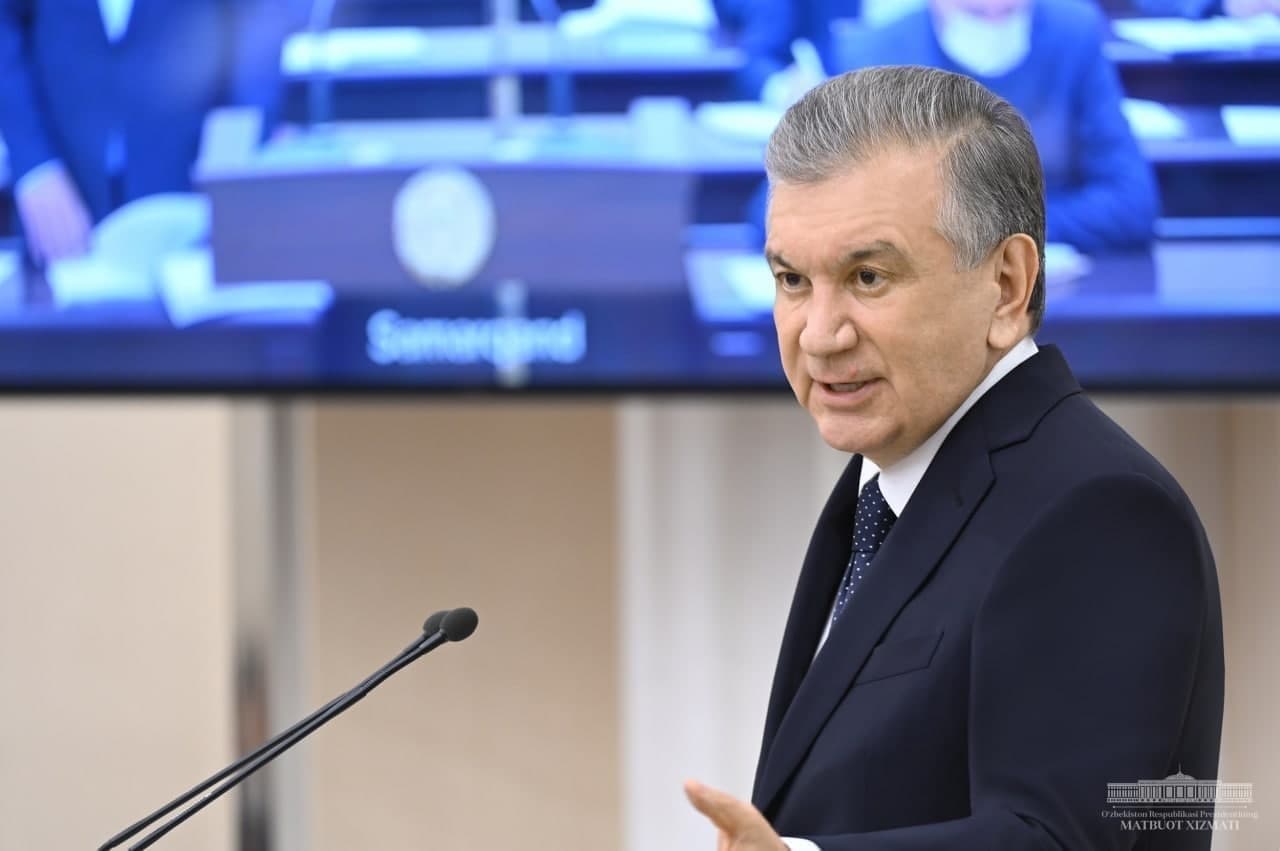

BAKU, Azerbaijan, July 1. Uzbek President Shavkat Mirziyoyev reviewed a package of proposals aimed at transforming Uzbekistan into a major Eurasian transport and logistics hub, with plans to expand logistics infrastructure, improve border crossings and attract billions of dollars in private investment.
This was reflected in the statement published by the press service of the Uzbek president.
During a presentation, officials outlined measures to capitalize on Uzbekistan's strategic location at the crossroads of Asia and Europe by increasing the country's share of international transit traffic and strengthening regional transport corridors.
According to the presidential press service, Uzbekistan currently has 4,000 kilometers (2,485 miles) of international transit corridors and a 4,700-kilometer railway network, while logistics hubs are being developed in Tashkent, Navoi and Namangan. Navoi International Airport continues to serve as a key cargo hub on Eurasian air routes.
"The transport and logistics system has strategic importance for increasing the country's export potential, investment attractiveness and regional development," Mirziyoyev said, according to the presidential press service.
Officials said the construction of the China–Kyrgyzstan–Uzbekistan railway and the accelerated implementation of the Trans-Afghan Railway would significantly strengthen Uzbekistan's position in regional and international transport networks.
Once completed, the projects are expected to establish the shortest overland route between the Pacific Ocean and Europe, reducing cargo delivery times to eight days—about three times faster than traditional transport routes. The corridor would also provide Uzbekistan with access to Pakistan's Karachi and Gwadar ports, opening a direct gateway to the Indian Ocean and the rapidly growing markets of South Asia.
Despite these advantages, officials acknowledged that Uzbekistan currently captures only 1% to 2% of transit flows between China and Europe.
Annual trade between China and Europe totals approximately $800 billion, with freight volumes estimated at 120 million to 150 million metric tons.
According to government estimates, increasing international transit volumes by an additional 15 million to 20 million tons annually could generate $400 million to $600 million in additional revenue, attract $3 billion in foreign investment for logistics infrastructure and create 50,000 permanent jobs, while boosting annual economic growth by up to 2 percentage points.
In 2025, Uzbekistan handled 15.3 million tons of transit cargo, a 54% increase compared with 2021.
However, the presentation highlighted several infrastructure challenges, including limited border-crossing capacity, an insufficient number of high-standard logistics centers, shortages of modern warehouses and cold storage facilities, and the need for greater digital integration across the logistics sector.
To address these issues, officials proposed developing Khanabad, Angren, Yangiyul District, Akhangaran District, Alat District and Termez District as specialized logistics hubs serving key international transport corridors.
Khanabad would become a gateway for routes linking China with Central Asia, the Caspian region, the Caucasus, Europe, Iran and the Trans-Afghan corridor, while Alat would serve as the principal hub for the Middle Corridor connecting China with Europe via the Caspian Sea and the South Caucasus.
Termez would be developed as the country's primary gateway for the Trans-Afghan transport corridor, linking Central Asia with Pakistan.
To encourage private investment, the government plans to allocate 50 hectares (124 acres) of land in each of the six designated logistics zones, 300 hectares in total, and provide up to $200 million annually in preferential financing for logistics projects. External infrastructure, including roads and utilities, would be financed through the state budget.
Additional proposals include constructing new customs terminals and truck parking facilities in Kibray and Termez districts, establishing an international railway border crossing in Khanabad, expanding the railway station in Yangiyul and building a Category A logistics center in Akhangaran.
Officials also proposed accelerating the digital transformation of the sector by integrating terminal and warehouse management systems with the national E-logistika platform, introducing real-time cargo monitoring, automatic license plate recognition and electronic vehicle registration.
The government also plans to streamline customs clearance through a "one-stop" border control system and simplify customs duties and certification requirements for importing modern logistics equipment.
Mirziyoyev instructed officials to accelerate the development of international transport corridors, expand the country's logistics network, digitalize the sector and create more favorable conditions for private investment as Uzbekistan seeks to establish itself as a leading logistics hub connecting East and West.



