


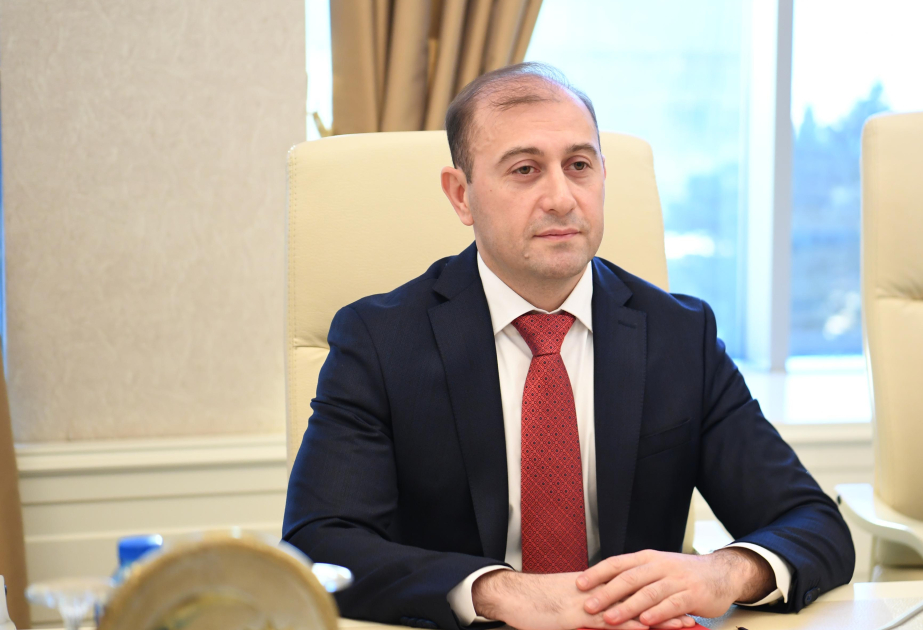

BAKU, Azerbaijan, July 9. Cybersecurity, against the backdrop of deepening digitalization and changing geopolitical situations, has already become not just a technical issue, but a direct issue of national security, Chairman of the Temporary Commission against Foreign Interference and Hybrid Threats of the Azerbaijani Parliament, Ramid Namazov, said, Trend's correspondent reports from the event.
He made the remark during a public debate in the parliament on the topic "Digital development, artificial intelligence and protecting children from harmful effects on social network platforms."
The MP noted that the rapid development of artificial intelligence, the creation of data centers, and digitalization are no longer just technological trends, but have become strategic factors that determine the future economic position, competitiveness, and national security of countries.
Namazov pointed out that the strategic foresight of President Ilham Aliyev played a special role in the establishment of Azerbaijan's digital architecture and in the digital transformation in general, and all stages of this process are connected with the personal participation and decisions of the head of state.
According to the MP, it's enough to look at the legal acts adopted in the last four years to understand the scale of the work done.
The commission head reminded that on February 11 of this year, a consultation was held under the chairmanship of President Ilham Aliyev, which became the basis for the unified action plan called "Azerbaijan's New Digital Architecture". During that consultation, it was noted that the application of artificial intelligence, the creation of data centers, and reforms in the field of digitalization determine the future development of countries, and Azerbaijan should include this direction among its priorities.
Namazov emphasized that during the consultation, the unique advantages that Azerbaijan has in this area were mentioned.
According to him, the first advantage is the country's location between Asia and Europe, on the East-West and North-South transport corridors, and the potential for transforming the existing transport and energy infrastructure into fiber-optic corridors.
He added that the second advantage is energy potential. Over the past 20 years, Azerbaijan's generation capacity has almost doubled, reaching 10,000 megawatts, and currently, there is at least 2,000 megawatts of unused capacity, which is a prerequisite for data centers and artificial intelligence infrastructure.
According to the commission chairman, it was emphasized at the consultation that digitalization is not an option, but a necessity, and the importance of a comprehensive approach to the issue was noted not only from the technological perspective, but also from the perspective of human capital, investment environment, national security, and international position.
Namazov said that at the next stage, institutional mechanisms were created in the field of digital development. According to him, the Digital Development Council was established by the decree of President Ilham Aliyev, and the Council, chaired by First Vice-President Mehriban Aliyeva, was entrusted with the function of coordinating and supervising the implementation of the measures envisaged in the "Action plan for accelerating digital development in Azerbaijan for 2026-2028".
He noted that President Ilham Aliyev has defined strategic directions, national priorities, and a long-term vision, and First Vice-President Mehriban Aliyeva is implementing this vision, coordinating between institutions and monitoring the results.
Namazov stressed that the leadership of the First Vice-President in this process shows that digital development is one of the highest priorities for the state and confirms that Azerbaijan's digital transformation policy has entered the stage of systematic institutional management.
The commission head said that at the first meeting of the Digital Development Council held on June 29, First Vice-President Mehriban Aliyeva delivered important messages. According to her, the speech emphasized the importance of studying international experience and applying successful models, as well as the need to make all decisions in accordance with the national interests and real needs of Azerbaijan.
Namazov added that the goal of the Council is not only to introduce new technologies, but also to give a strong impetus to the country's economy, attract investments, support local startups, and create a more efficient public administration system.
He said that the topic of cybersecurity was also one of the main issues of the meeting. According to him, artificial intelligence is developing faster than expected, and this creates new opportunities as well as new threats. Therefore, it is more important than ever to be prepared for risks in the field of cybersecurity and information security.
Namazov pointed out that in parallel with the deepening of digitalization, the number, scale, and complexity of cyberattacks, which are an important component of hybrid threats, are rapidly increasing. The World Economic Forum also assesses cybersecurity risks and insidious activities carried out through technologies at the forefront of the list of global threats.
According to him, cyberattacks carried out using artificial intelligence, supply chain risks, and targeted threats against critical information infrastructure have already become an everyday reality.
The chairman of the commission recalled that at a consultation held in February, President Ilham Aliyev announced that Azerbaijan had been subjected to an organized and aggressive cyberattack last year. He added that the commission also periodically, and in special cases, informs the public about hybrid threats carried out against the country.
Namazov underscored that all this shows that as the digitalization process deepens and the geopolitical situation changes, cybersecurity is no longer a technical issue, but directly a matter of national security.



