


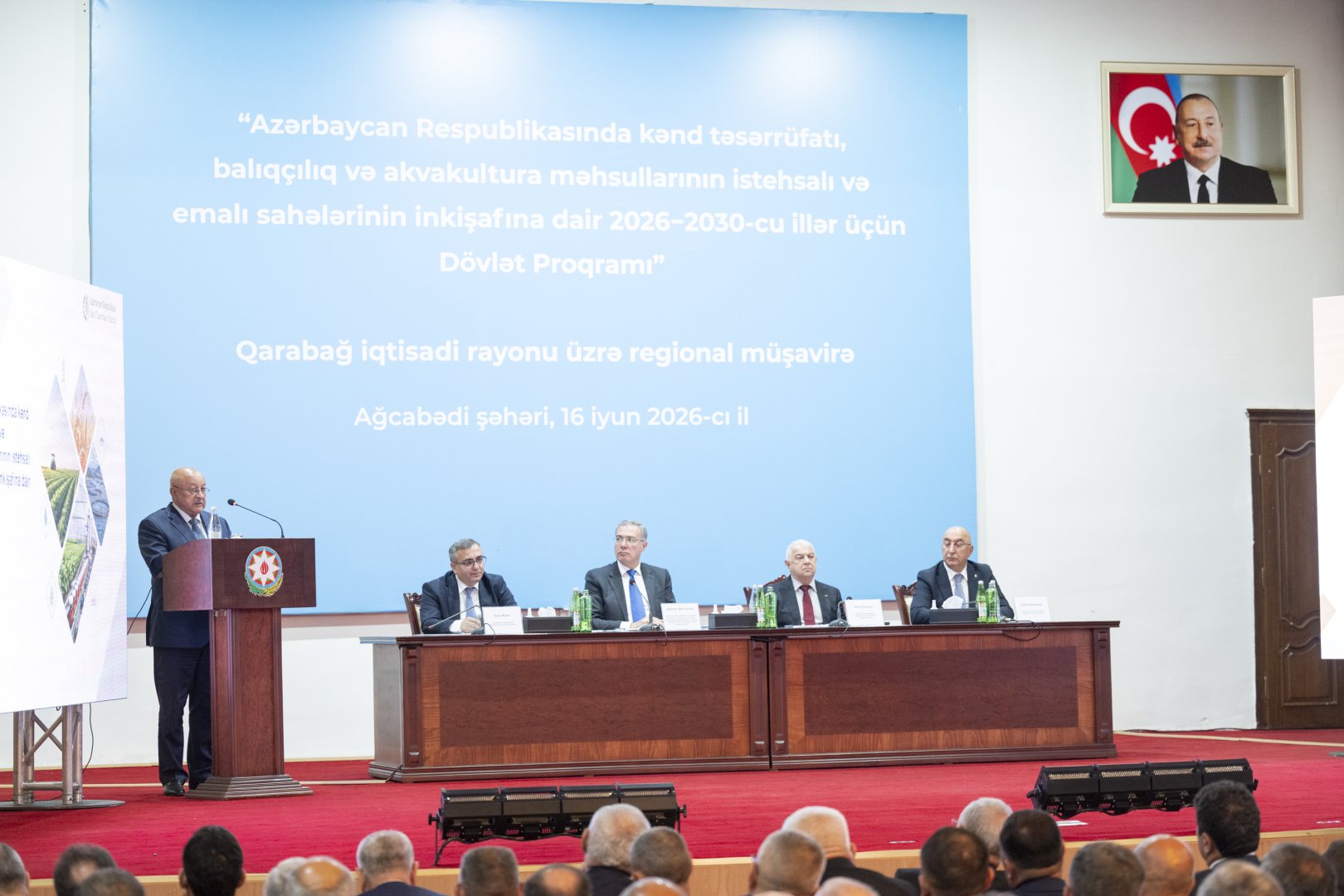

AGHJABADI, Azerbaijan, June 16. Modern irrigation systems will be installed on an additional 5,000 hectares of land in Azerbaijan’s Aghjabadi district next year, according to the head of the district executive authority, Trend's Karabakh bureau reports from the event.
This was stated by Rafil Huseynov, Head of the Aghjabadi District Executive Power, at a regional meeting in Aghjabadi dedicated to discussions on a state program for agricultural, fisheries, and aquaculture development for 2026–2030.
According to Huseynov, seed fairs and festivals organized by the Ministry of Agriculture have been one of the key factors behind increased grain productivity in the region in recent years.
He said expanded access to high-quality, certified, and regionally adapted seeds has helped double yields in the agricultural sector.
According to him, 16% of arable land and 26% of grain crops in the region are currently equipped with modern irrigation systems. He added that drip and sprinkler irrigation technologies are already used on more than 2,000 hectares of small farms.
Huseynov said that next year, pivot irrigation systems will be installed across an additional 5,000 hectares, further expanding modern irrigation coverage in the district.
According to him, Aghjabadi is expected to become one of the key contributors to the national target of bringing 300,000 hectares of farmland under modern irrigation systems, set by President Ilham Aliyev. He added that reconstruction of the Karabakh Canal will significantly improve regional water supply.
He also said the main goal in cotton production is to raise yields to 50 centners per hectare. According to him, the Aghjabadi branch of Prime Cotton LLC achieved an average yield of 41 centners per hectare last year, while 298 farmers exceeded 45 centners.
However, he noted that factors such as the use of unsuitable seeds, pests, technical shortcomings, defoliation issues, and harvest losses continue to negatively affect overall output.
According to Huseynov, reaching 50 centners per hectare would reduce production costs to around 5,000 manats ($2,950) per hectare. He also said weed control alone accounts for 25–30% of production costs in some years, making the wider use of modern pesticides, machinery, and drone technologies increasingly important.
He added that plans are also underway to develop cotton processing industries, including yarn and textile production, as well as cold storage facilities for agricultural goods and intensive horticulture farms.
According to him, entrepreneurs implementing new investment projects will receive support through preferential credit and subsidy mechanisms.



