


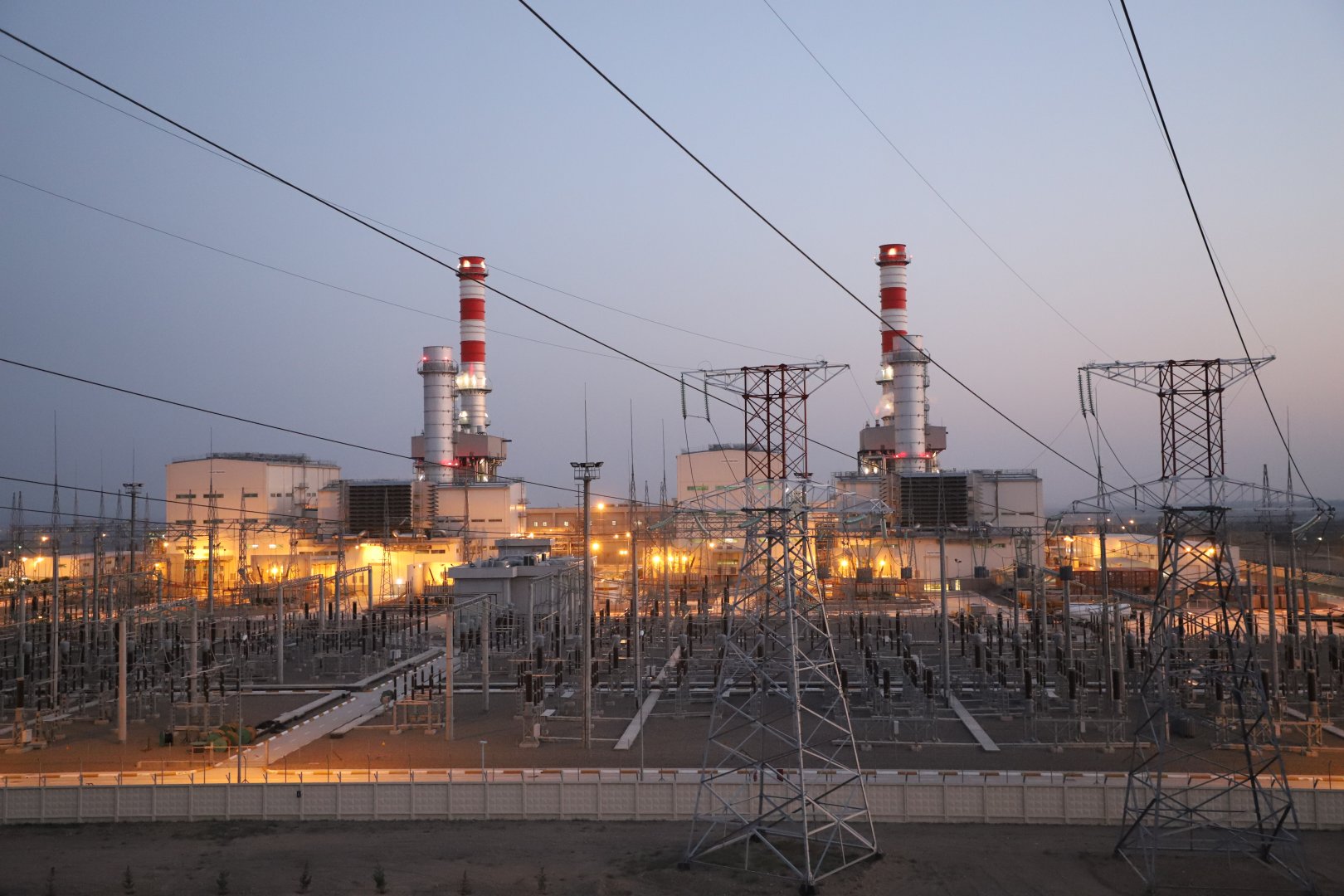

TASHKENT, Uzbekistan, December 11. Uzbekistan is set to commission five new thermal power plants with a total capacity of 4,183 MW by 2027, Uzbekistan’s Ministry of Energy told Trend.
These projects are being implemented under public-private partnerships and agreements with foreign companies. The construction of new power plants will improve the country's energy security and stabilize electricity supply for both the population and the economy.
By 2027, Uzbekistan will have 12 new state-of-the-art thermal power plants, with a total capacity of 7,057 MW. These plants will be commissioned between 2022 and 2027 across various regions, including the Syrdarya, Tashkent, Kashkadarya, Jizzakh, and Surkhandarya regions. The total project cost is estimated at $4.86 billion, with foreign investments from Germany, France, Japan, the Netherlands, Qatar, and Türkiye.
In particular, in 2024, a 400 MW thermal power plant will begin operations in the Nishan district of the Kashkadarya region. As of now, 315 MW of this project has already been commissioned. Additionally, in 2024, the 4th thermal center in Tashkent will add 100 MW to the grid. In 2025-2026, a 1,573 MW thermal power plant will be built in the Syrdarya region, and by 2027, four more plants will be launched, including one in Jizzakh with a capacity of 550 MW and one in Surkhandarya with a capacity of 1,560 MW.
Moreover, in 2024, two gas turbines at the Tashkent Thermal Center will be commissioned, adding a total of 64 MW. The commissioning of cogeneration boilers in Tashkent, which will add 20.9 MW, is also planned.
In recent years, Uzbekistan has been actively developing renewable energy sources, and several large solar and wind power plants are set to be commissioned in the coming years. A total of 38 agreements with international companies have been signed for the construction of solar and wind power plants, with a total capacity exceeding 20,000 MW. These projects will significantly reduce reliance on natural gas, improve the environmental situation in the country, and strengthen energy security.



